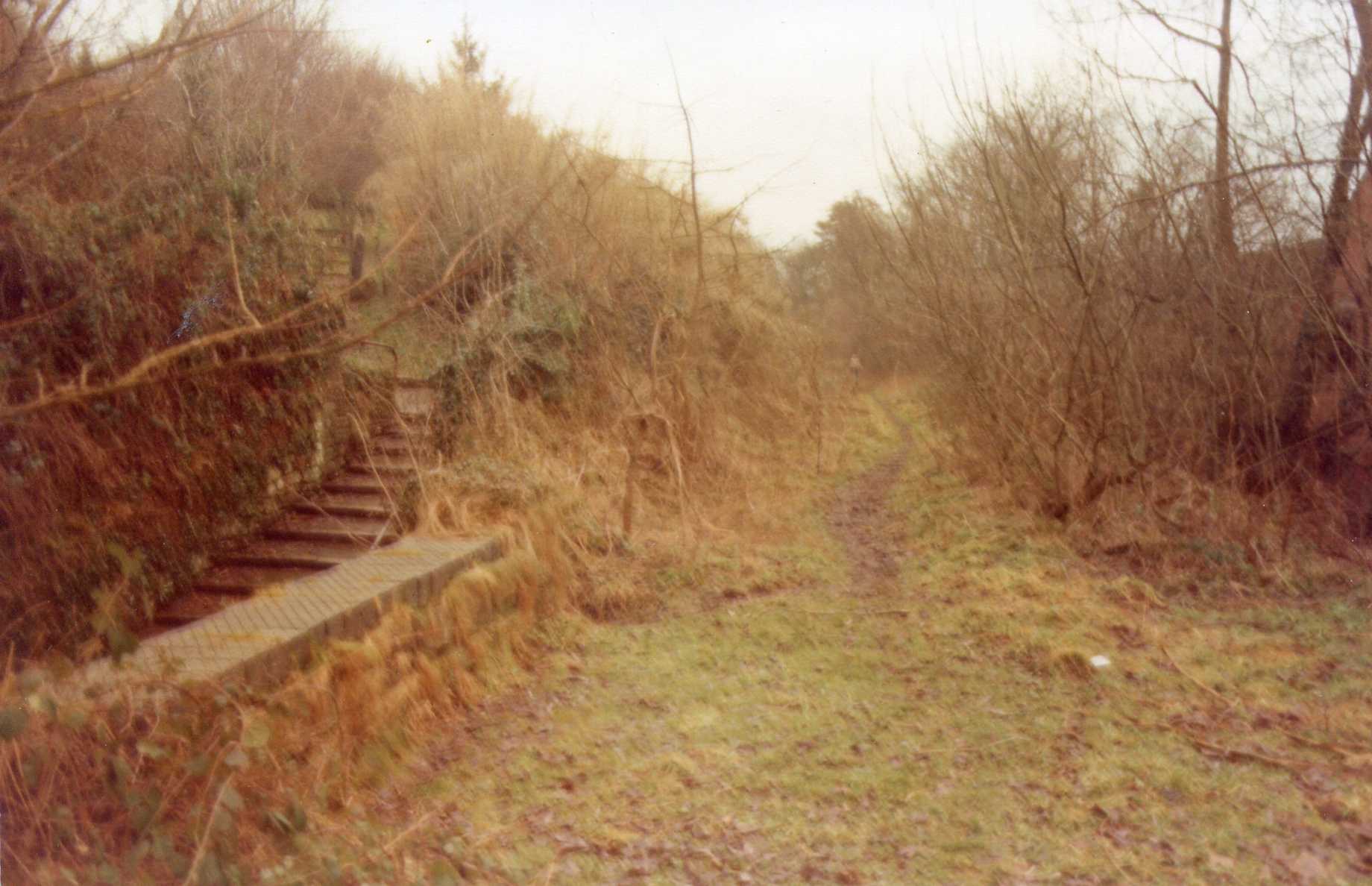
The railway from Stonehouse to Nailsworth is long gone, although a healthy length of footpath and cycle way along its course was rescued from the undergrowth in the 1990s. Today it requires an effort to imagine it in its heyday – clean ballast, shiny rails, no encroaching vegetation, open to view, economically active and to some degree important. Sadly even those of us who remember it in operation know only a scene of decline, decay and withering closed stations. It opened in 1867 in a pre-motor vehicle age and was a vital means of local transport when the valley bottom was still boggy and difficult to navigate. Local industry needed it, especially for bringing coal in from the Forest of Dean. After a year as an independent company the Stonehouse and Nailsworth Railway was absorbed into the Midland Railway, one of the larger private railways of the era.
Using Midland Railway records available online I have attempted to identify those who worked on the line during its early decades; in some cases following the thread of personal stories. The job titles and roles, pay rates and differentials, staff turnover, transfers between stations, within the branch and further afield, give a flavour for how the line was manned, organised and functioned. The records are extensive but may not be comprehensive. They include lists of those who’d worked at each station from 1871 to 1908, ledger entries of individuals hired between 1868 and 1882. the salaried staff at each station in 1914, a small number of career summary cards, and ledger entries of injuries suffered during the branch line’s Midland Railway era.
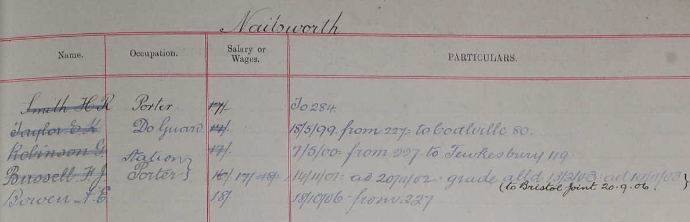
The staff mentioned are those allocated to one of the stations on the line, which were – Stonehouse, Ryeford, Dudbridge, Woodchester, Nailsworth, and Stroud (Wallbridge) which was at the end of a spur from Dudbridge. These employees do not include locomotive crew, such as drivers and firemen, nor track maintenance workers, such as Gangers and Platelayers (except in the case of injuries) which were under other Departments of the railway. I have write a separate piece about the mishaps and injuries on the line; for that go to this link.
The available records do not quite stretch back to the opening of the line in 1867 so I am not able to positively identify the staff who were there at the very beginning. However a few who are mentioned had evidently been in post for some time and may have been there at the start. There is mention of a chap called Little being offered a Porter’s position at Ryeford in October 1868 but he declined the appointment. So the first definitive employee on the line, in the records, was William Clayfield who is documented as being an Assistant Porter at Nailsworth in November 1868 on 10 shillings/wk.

He was a local lad born at Horsley around 1850, the son of a local Stonemason. The 1871 census has him as a Porter at Nailsworth; a slightly higher rank that “Assistant”. He made the railway his life and career. By the 1881 census he is the Station Master at Higham-on-the Hill, in Worcestershire, and married to Mary, from Nailsworth, 4 years his senior. On the 1901 census he is still in that position but by 1911 he is the Station Master at Nuneaton.
Another early employee was W. Chapman who was taken on as an Assistant Porter at Nailsworth on 22nd August 1869, but on 6 shillings/wk compared to William Clayfield’s 10 shillings. The difference is probably due to age, though the age of the employee is only stated in about 8% of the records I’ve accessed.

Young lads were taken on as Office Youths, Machine Youths or Machine Clerks. If a little older one could be a Carriage Washer, though that grade is only mentioned at Nailsworth where perhaps coaches might have been stabled or needed attention when in use. These job descriptions were not used for those over 18. The 1891 census has George Saunders living in digs opposite the Goods Yard and is described as a “Steam Raiser (on Railway)” so maybe locos were also stabled there; but this is only a guess. A few lads had other roles. L.G.H. Brier was a Clerk at Nailsworth when just 15 though still only on 8 shillings/wk like the others of his age. Some were logged as Assistant Porters but in reality whatever the job title they probably undertook a multitude of overlapping tasks as would be needed on a lightly staffed branch line. There is no indication of any female employees.
The youngest starter that I have found was Samuel Edward Roberts who was appointed an Office Youth at Nailsworth, aged 13, on 31st January 1883, on 6 shillings/wk. He was “discharged” from the post on 1st March 1890.

Of the seven identified as joining the railway aged 14 three were appointed Office Youths, 2 Machine Youths, one an Assistant Porter and one a Gateboy. Six of them started on 6 shillings/wk. The one exception was William George Wearn who was taken on as an Office Youth at Woodchester in July 1889 on £20 per year, equivalent to about 7/6 per week. Perhaps he showed promise because he was one of the branch line’s career climbers and by 1912 he was a Relief Station Master at St Pancras – the Midland Railway’s prestigious London terminus – but that lay in the future and in the meantime Frederick William French might have felt aggrieved as he started in the same role, but at Nailsworth, a month later on only 6 shillings.
Gateboys and Gatemen, were positions specific to Stonehouse Station.
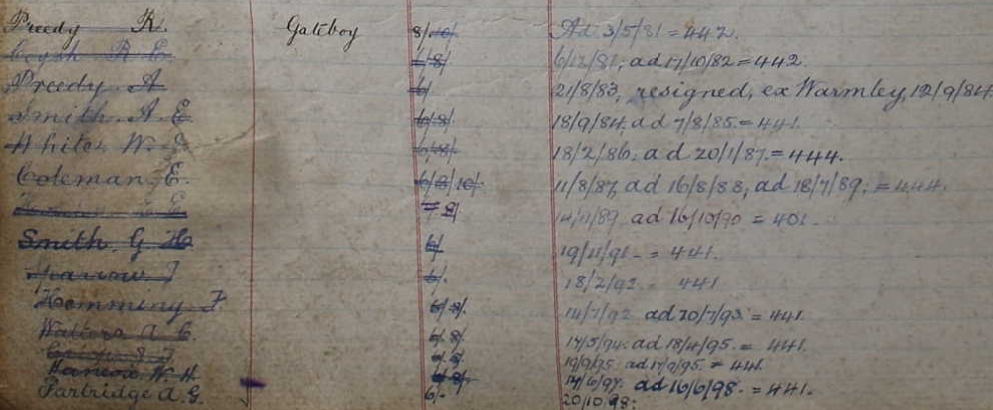
None of the other stations on the branch had them. This was probably related to the fact that two of the three platforms at Stonehouse straddled the Gloucester- Bristol main line; a more dangerous place with higher intensity of traffic and non-stopping trains passing at speed. Between 1873 and 1906 the pay for Gatemen ranged from 16 to 20 shillings per week compared to the measly 6 shillings for Gateboys.
The roles for men including: Station Master, Clerks of various types, Porter and Assistant Porter, Guard, Signalman, Pointsman and Foreman. In some instances an individual would perform more than one role. At Stonehouse in 1884 G.A. Prude was a Station Porter, Guard and Shunter starting on 14 shillings/wk; he resigned in on the 24th March, 1904.

Porter Guards were more common at Stroud than at any of the other stations on the branch. There were 9 between 1887 and 1903 with a pay range of 17 to 20 shillings/wk.

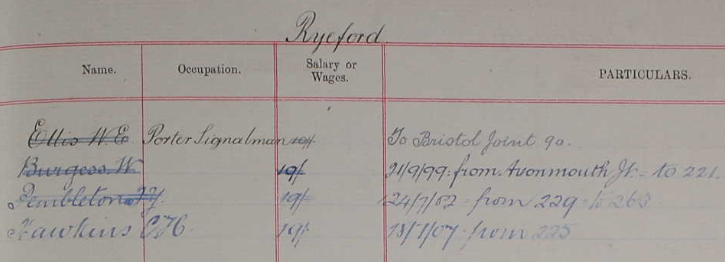
Nailsworth had just 3 in the same period. Porter Signalmen were a feature of Ryeford with 7 between 1892 and 1907, each receiving 19 shillings/wk. Stonehouse was the only other place where this role existed with just 2; mentioned in 1884 and 1891. The term Station Porter is used on the branch after 1897, except for one at Stroud in 1887 and one at Ryeford in 1891.
The Stations compared
The records of the employees that I have examined mainly cover the period 1871 to 1908. However a stand-alone document from 1914 lists the pay of the salaried staff at each station. The level of pay may reflect the responsibilities, commercial activity and relative importance of each station compared to others on the line. However the level of seniority, hours worked, or time in post, may also be a factor.
The Station Masters’ annual pay was:
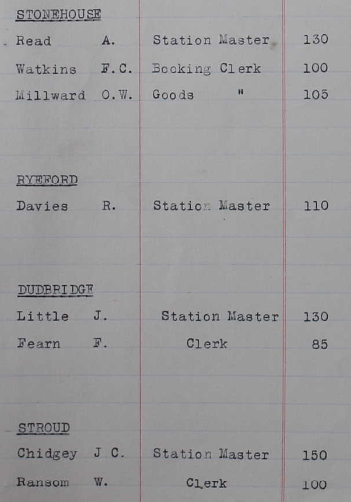
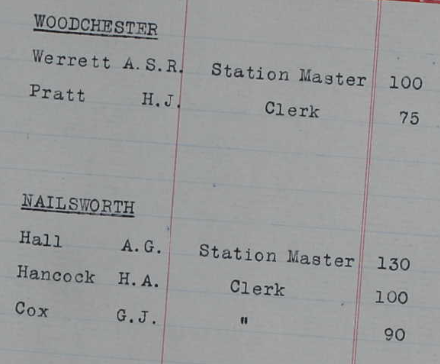
- Stroud J.C. Chidgey £150
- Nailsworth A. J. Hall £130
- Stonehouse A. Read £130
- Dudbridge J. Little £130
- Ryeford R. Davies £110
- Woodchester A. Werrett £100
The Clerks’ annual pay was:
- Stroud W. Ransom £100
- Nailsworth H.A. Hancock £100, C. J. Cox £90
- Stonehouse F.C. Watkins (Booking) £100, O. W. Milward (Goods) £105
- Dudbridge F. Fearn £85
- Ryeford none listed
- Woodchester H.J. Pratt £75
One might deduce from this that Stroud was the most important, commercially, of the branch’s stations, more so than Nailsworth, even though the spur to Stroud was build some 20 years later than the rest of the line. This would make sense as Stroud was a larger town. The Station Master’s pay at Stroud had initially been equal lowest on the line but progressively increased to finally exceed that at the other stations. The relatively high pay of the Station Master at Stonehouse was likely related to it being a combined station with part serving the main Gloucester-Bristol line and part the branch line. Dudbridge’s important lay in it being a junction with significant goods sidings. Ryeford probably ranked above Woodchester as it had sidings servicing Kings Stanley Cloth Mill and a timber yard adjacent to the StroudWater Canal. Woodchester was more modest, and the only station on the line without a stone building, and with sidings just to Workman’s Saw Mill.
Nailsworth:
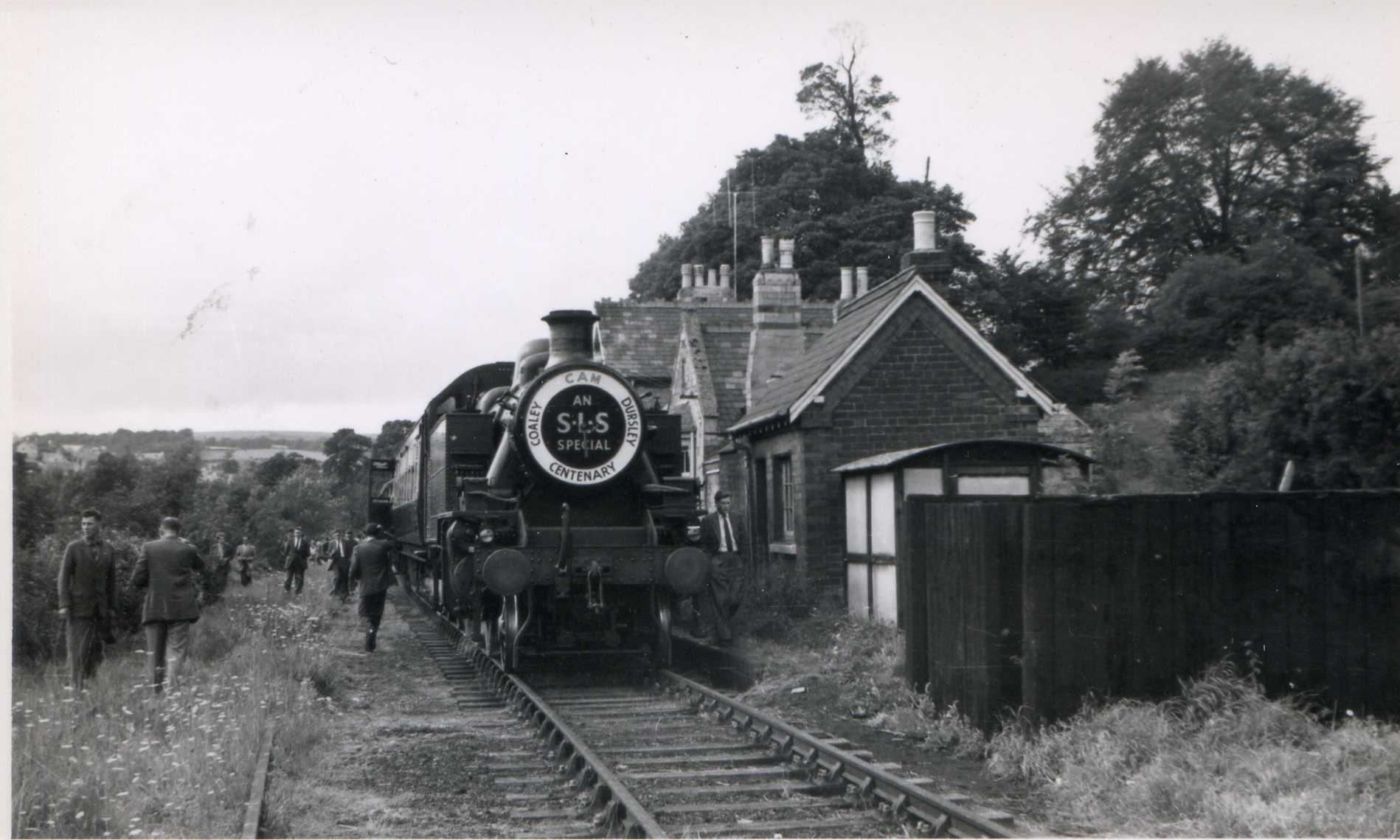
rail tour in August 1956.
Between 1871 and 1908 Nailsworth saw the largest throughput of staff of any station on the branch: 5 Station Masters, 42 Porters, 22 Assistant Porters, 3 Station Porters, 3 Porter Guards, 1 Goods Porter, 1 unspecified Assistant, 11 Carriage Washers, 26 Clerks, 4 Foremen, 2 Guards, 6 Machine Clerks, 9 Machine Youths, 4 Office Youths, 3 Passenger Guards and 1 Pointsman; a total of 143. The only mention of Signalmen at Nailsworth relates to Edward Smith who had his grade altered from Signalman to Porter, and his pay reduced from 21 to 17 shillings/wk, on 13/7/1886.
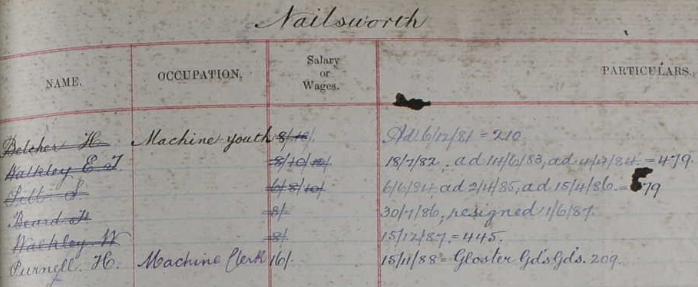
What the Foremen were overseeing is uncertain but perhaps it related in some way to the Goods Yard; which was the case at Stonehouse where the term”Goods Foreman” was used. George Burcher, formerly of the Goods Dept, appears to have been taken on as Foreman at Nailsworth on 5th October 1875 after the death, 7 months earlier, of H. Adams who had been a Goods Porter. They are listed together in the records. George is described in the 1891 census as “Railway Foreman”. He died on 10/5/1899 and was succeeded by A.E. Ham, then A.E. Hall in November 1900 and W.J. Cole in September 1901.
The Carriage Washers were lads aged between 15 and 18, with pay between 8 and 12 shillings/wk. It was a job title unique to Nailsworth. It was not used elsewhere on the branch.

The Machine Youths, Office Youths and Machine Clerks, where age is give, were from 13 to 16, and usually on 6 to 8 shillings/wk; though 2 Machine Clerks were on 16 shillings/wk, perhaps because they were older. These young men were likely trying work on the railway for the first time and some don’t seem to have taken to it. Among the Carriage Washers George Henry Sawyer lasted just 3 days over Christmas 1881; he was deemed “unsatisfactory”.

Caleb Stephens was called upon to resign after 5 months in June 1885 and Oliver Horwood was discharged in November 1890 after 3 years in post. Others, who resigned, apparently of their own volition, were Albert Mills (1885), Harry Godfrey (1890) and Henry Jones (1887); overall a dropout rate of 55%. Among the “Machine” grades it was somewhat less affecting 26% – 5 of the 19 individuals, including E. Benjamin Hill, a potential Machine Youth, who was “unable to pass the doctor” in July 1887.
The relatively large number of Clerks gives an indication of the paperwork and administration needed to service the quantity of passengers and goods transiting through the station. The 26 Clerks are though spread over 35 years or so. The 1891 census gives some indication of the approximate makeup of the team allocated to the station at that time – the Station Master, 2 Clerks, 2 or 3 Porters, 2 Guards and the Foreman. However this doesn’t represent all the railwaymen working in the vicinity. The 1891 census mentions locomotive footplate crew living close to the station but these men were probably allocated to the Locomotive Department and not counted on the tally of the station staff. Also living close to the railway at Nailsworth didn’t mean one worked there. Albert Liggins lived at Watledge and is documented as a “Railway Guard” in the 1891 census but this was at Stroud where he’d been appointed just 2 weeks before the census was held. That he was still living at Nailsworth is unsurprising as on 16/8/1888 he’d been appointed as a Porter there on 14 shillings/wk, increased to 17 shillings on 17/12/1889 – a nice Christmas present. With the move to Stroud he was now on 20 shillings/wk. Sometime later he moved onto Wellingborough.
I have written a separate piece on the first five Station Masters at Nailsworth up to the First World War; for this go to the link.
Woodchester:
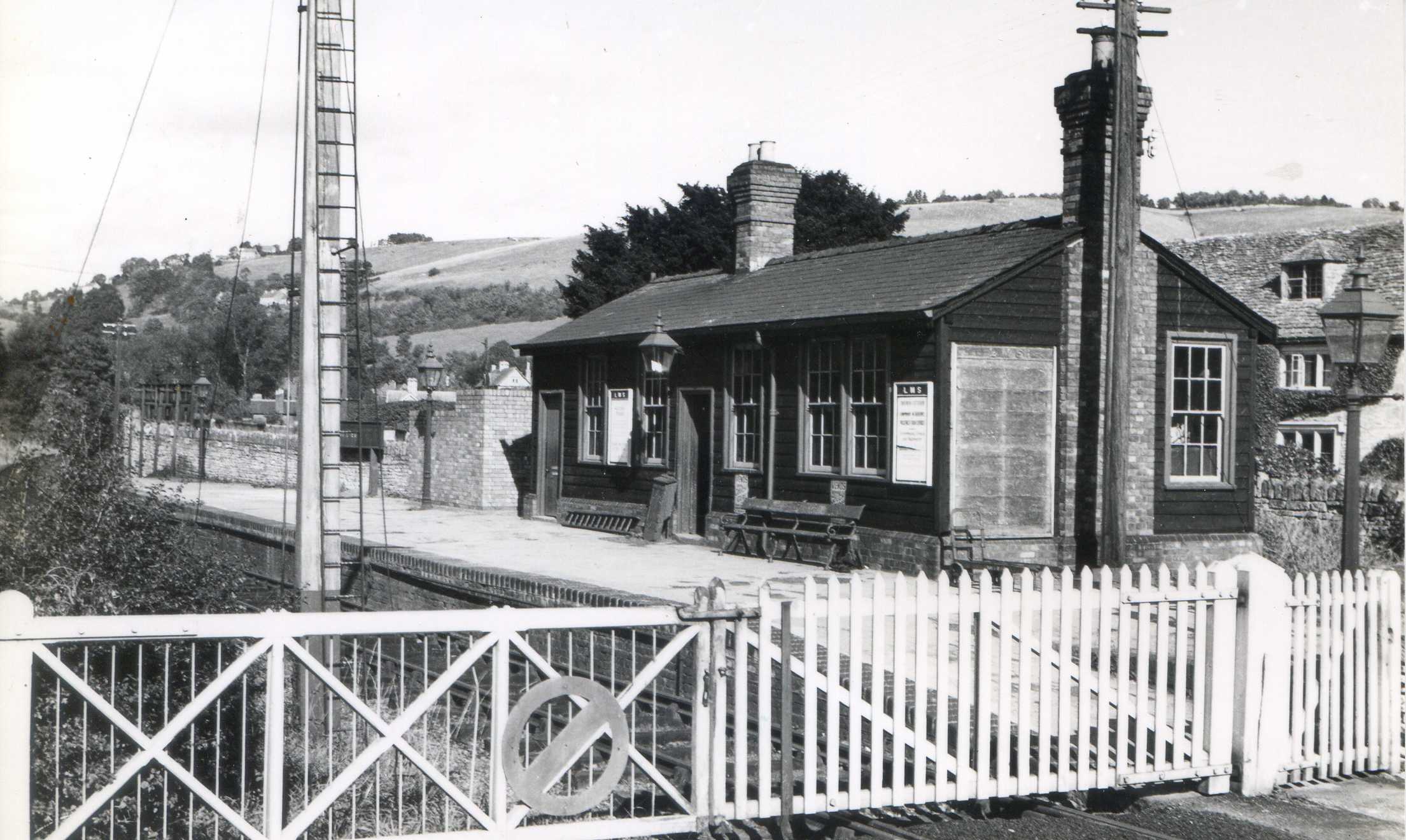
Between 1871 and 1908 Woodchester saw a surprisingly large number of Station Masters – 10 in all; more than any other station on the branch. Being such a small station perhaps it was a career stepping stone to greater things – and yet A.S.R. Werrett who started in November 1904 was still there in 1914.
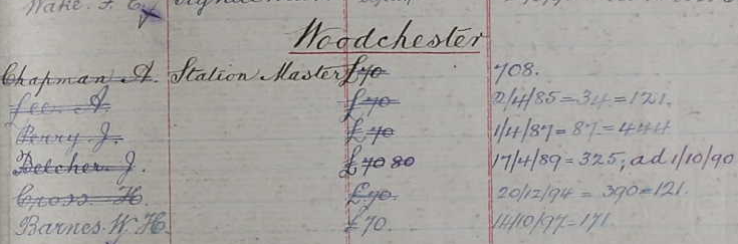
In the early years there was little advancement in pay. The first recorded post holder, W. Barns, was on an annual salary of £67-12 shillings in 1871. On 16/12/1873 H. Wells received a pay rise to £70. In October 1878 J. White found some advancement in moving to Ryeford as Station Master where the pay was £76-10 shillings. He was replaced immediately at Woodchester by A. Chapman on £70. When W. H. Barnes came to the post in 1897 it was still at that level. His successor J. Archer got £80 in 1902. By 1914 it was £100 but still the lowest for that rank on the branch.
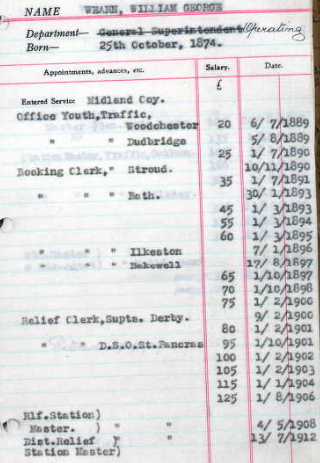
The other staff during this period were 15 Porters, 11 Office Youths, 5 Clerks, and 4 Assistants, with the Station Masters, a total of 45. In the 1870s the contingent seems to have been the Station Master, a couple of Porters and an Assistant. During the 1880s and 1890s an Office Youth was part of the team in place of Assistants. Perhaps by then activity was sufficient to offer some useful training with each lad staying 1 to 2 years. The starting pay was 6 to 10 shillings/wk with approximately annual increases in increments of 2 shillings. W.E. Simms resigned on 20/11/1889 after his 2 year stint but the others seem to have gone on to other railway roles. By 1912 William Wearn, who’d started out as an Office Youth at Woodchester age 14, was a Relief Station Master at St Pancras. Others progressed more locally. In April 1900 both F.R.S. Richards and A.W. Barnfield became Clerks, at Nailsworth and Stonehouse respectively. Stonehouse paid better, £35 compared to £25.
From March 1900 there was a Clerk at Woodchester. However the pay for that grade seems to have been less than elsewhere on the branch and both R.R. Smith and A.J. Harnden moved to similar positions at Nailsworth to improve their income from £20 to £25, in 1904 and 1905 respectively. The pay differential is evident in the 1914 salary document – see table above.
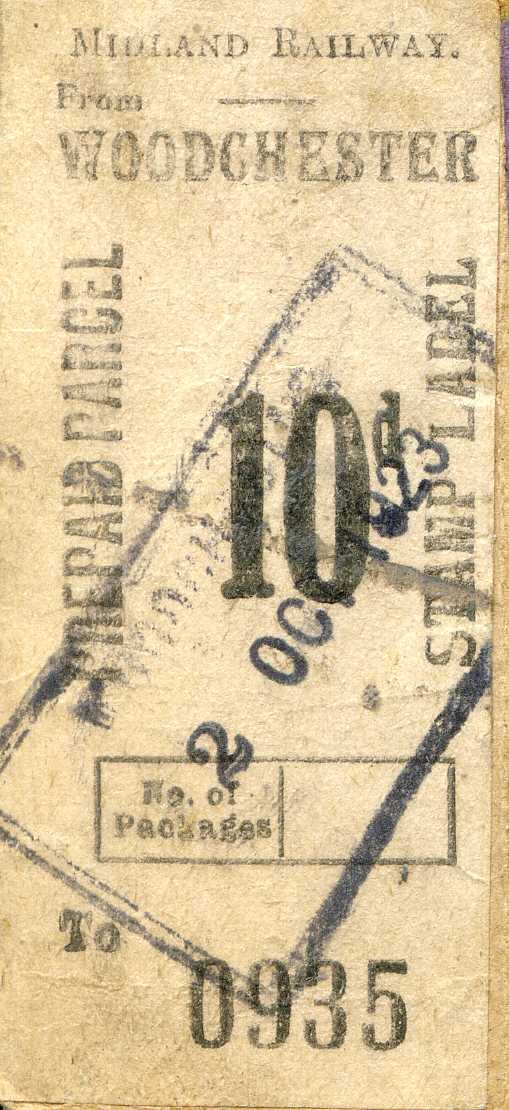
Several of the Porters resigned – G. Iles 16.5/1873, J. Lanning 15/12/1874, C. Averil 1/10/1874 (after only 8 months in post), W. Cashmore 16/10/1877 and F.M. Lucas 24/7/1884. H.A. Adams, the last of the Assistants, was “called upon to resign” on 21/5/1877. The reasons are not given.
On 19th January 1892 J. Belcher, the Station Master at Woodchester, was involved in an accident where the 7:55pm train from Stroud overran the buffers at Nailsworth. The train had departed Dudbridge inadvertently without a Guard. The driver stopped the train at Woodchester to report this and take instructions from the Station Master. He was told to proceed and the Station Master joined the train acting as the Guard. In the pitch black, and probably distracted by this previous hitch, the driver lost his bearings and failed to cut off steam and apply the brakes in time as he approached Nailsworth. For the Accident Report go to this link.
Dudbridge:
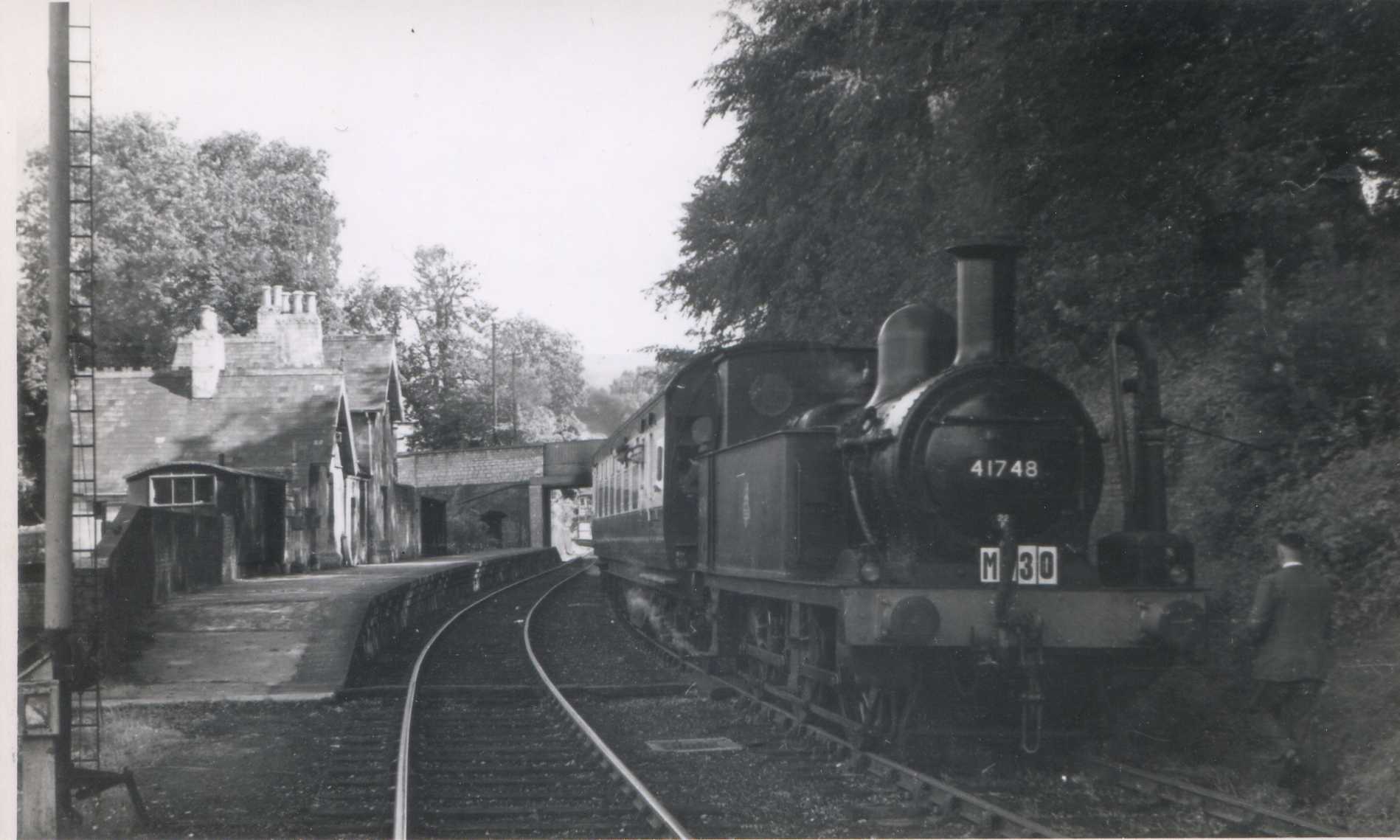
rail tour in August 1956.
From 1871 to 1908 there were 6 Station Masters, 22 Porters (includes 1 Station Porter), 13 Assistant Porters, 5 unspecified Assistants, 7 Clerks, 14 Machine Youths, 7 Machine Youths and 5 Signalmen; a total of 79 employees. However the mix of staff changed over the decades. One factor in this would have been the opening of the spur to Stroud in 1885 which made Dudbridge a junction. Signalmen are only mentioned from 1887 onwards.

The role of unspecified Assistant was only used in the 1870s. Office Youths only feature from 1882 whereas the first Machine Youth appears in 1873. There were no new appointments to either grade after 1897. Perhaps their tasks were taken on by the Clerks all of whom are appointed after 1900.
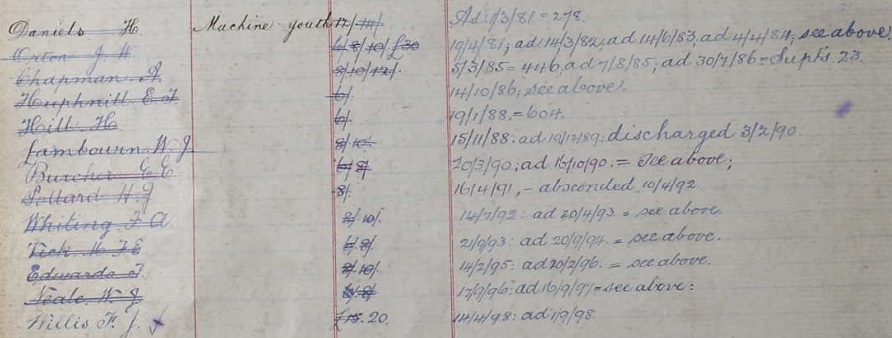
The position of Office Youth was a notch up from Machine Youth. Five lads were promoted to Office Youth after being Machine Youths for approximately 12 to 18 months. This came with a pay rise of 2 shillings on top of their previous income of 6 or 8 shillings/wk. The next step up seems to have been to the grade of Clerk. In August 1887 O.J. Screen moved from Office Youth at Dudbridge to Clerk at Nailsworth.
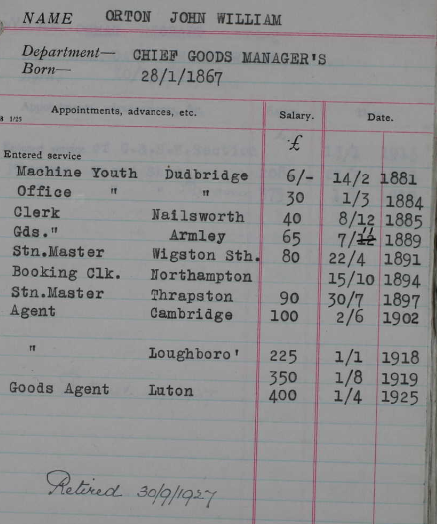
Career progression is most clearly seen in the case of John William Orton. We have the record of his 44 year railway working life. He began as a Machine Youth at Dudbridge on 14/2/1881 aged 14 on pay of 6 shillings/wk. He stayed rather a long time in that position rising to Office Youth after 3 years and pay of £30/yr (approx 11.5 shillings/wk). His next move, in December 1885, was to become a Clerk at Nailsworth. By April 1891 he was Station Master at Wigston South. After a period as a Booking Clerk at Northampton in the mid 1890s he became Station Master at Thrapston and finished his career as a Goods Agent at Luton in 1925 on £400/yr. He retired on 30/9/1927 at the age of 60 which seems to have been a fairly common age to call it a day for railwaymen.
Stroud (Wallbridge):
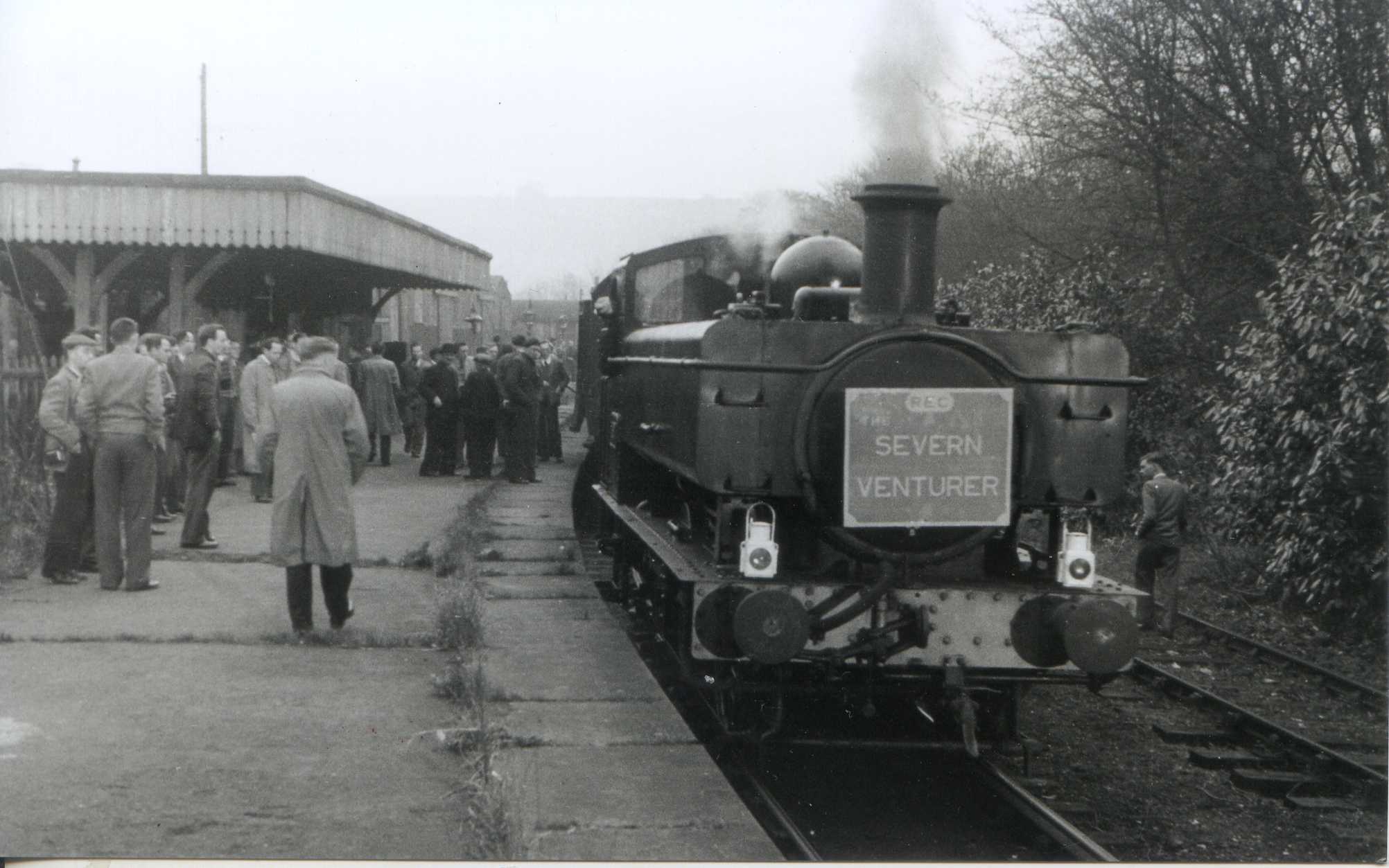
The spur from Dudbridge to Stroud was opened to Goods traffic in November 1885 and to Passenger traffic on 1st July 1886. However it may not have had its own dedicated permanent staff immediately. The employment records suggest a change in arrangements on 1st April 1887. On that day there were 6 new appointments of significance to the operation of the line to Stroud; four at Stroud and two at Dudbridge.
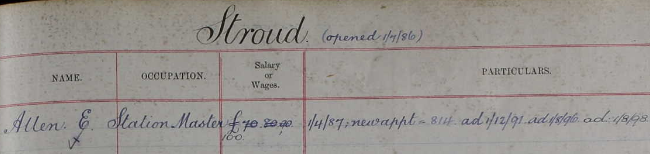
The new team at Stroud consisted of E. Allen as Station Master, on £70 per year, J. Fox as Station Porter and J. Barker as Porter Guard, both on 19 shillings/wk, and T. H. Shilton an Office Youth on 12 shillings/wk. With the coming into operation of the spur to Stroud, Dudbridge became an active junction and thus C. Woolecote (21 shillings/wk) and A. J. Watts (23 shillings/wk) were installed as Signalmen on this date; the latter specifically to the “Sidings Box”. An F.E. Wake is mentioned allocated to that box in 1899/1900. Before then there is no mention of Signalmen at Dudbridge in these records. Mr Woolecote resigned on 21/6/1889 and was replaced by W. Halford on 18/7/1889 but on the lower pay of 19 shillings/wk. A. Maggs and C. T. Archer joined the staff at Dudbridge as Signalmen in the Junction Box in 1890 and 1899 respectively.
In the two decades following the opening of the spur, Stroud saw 1 Station Master, 9 Porter Guards, 5 Station Porters, 5 Assistant Porters 1 Passenger Guard, 4 Clerks and 6 Office Youths; a total of 31.

During this time there is a hint, in the employee records, of the growing activity at the station. The Station Masters pay rises quite quickly. When appointed in 1887 it was £70, the same as his colleague at Woodchester, the smallest station on the line. Whereas the pay at Woodchester remained at this level until 1902, then rising to £80, the Station Master’s salary at Stroud rose to £80 in December 1891, then to £90 in August 1896 and to £100 in August 1898. By 1914 it was the highest on the branch at £150 per year. From January 1897 there was also a Clerk at Stroud. The first was W.J.S. Willoher on the lowly pay of 10 shillings/wk, which was increased to £35 annually, a year later. Clerks appointed in 1903 and 1903 received £55 and £60 respectively and by 1914 the incumbent was on £100/year; the same as the Station Master at Woodchester.
Ryeford:
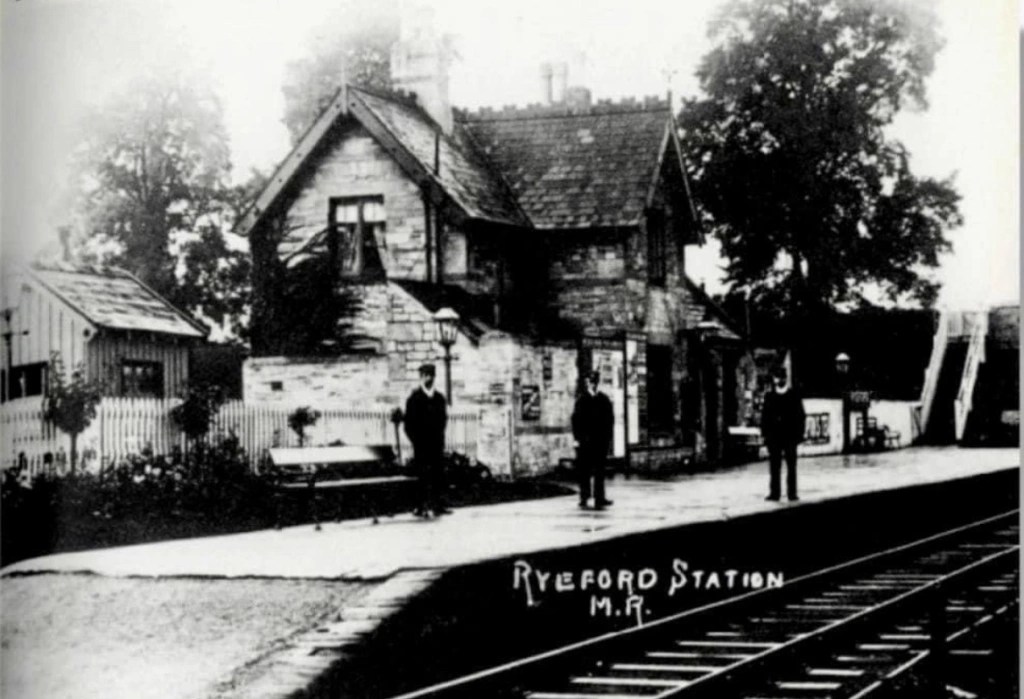
Between 1871 and 1908 the following staff worked at Ryeford at one time or another: 3 Station Masters, 30 Porters (includes 3 Station Porters), 4 Assistant Porters, 6 Porter Signalmen and 2 Signalmen; a total of 45. Of note – there were no Clerks.
C. Tarn may have been the first Station Master as he is listed at the start of the records in 1871. However an entry dated 18th January 1878 states that he was “incapacitated due to illness”. He was not replaced until 15th October that year when J. White took up the post. He then died on the 5th April 1885 being replaced in turn, on 16th July 1885, by J. Clayfield. He survived at least until 1905 as his pay was increased from £80 to £85 at that time.
The first appointment of a Signalman at Ryeford was R. B. Melmoth on the 1st April 1887, on 19 shillings/wk. This is the same date as the staff changes at Stroud and Dudbridge. Perhaps there were some general adjustments to the signaled sections of the line to increase train capacity. There is no mention of Signalmen at Ryeford in the records before 1887.
Melmoth was replaced a year later by H. J. Turner, on the same pay, and he remained in post until at least May 1897 when there is a record of a pay rise to 21 shillings. He would have been assisted in his duties by the Porter Signalman the first of whom, a R.G. Jones, was appointed in July 1892. There then seems to have been a steady turnover in the men holding this position with 6 in the role up to 1907.
The extra responsibility is reflected in their pay of 19 shillings/wk, whereas that for a standard Porter in the 1890s ranged from 8 to 16 shillings, and for Assistant Porters in the 1900’s from 8 to 12 shillings. Oddly the pay for Porters at Ryeford was a little higher in the 1870s with 7 of the 12 incumbents in that decade receiving 17 shillings/wk. Despite this three don’t seem to have enjoyed the job. In November 1872 H. Taylor resigned after only 10 days, and on 21st March 1872 A. Bamford was “discharged” as was J. French on 4th September 1873, after less than 6 months in post. However in August 1887 W.J. White, and in November 1889 E. Coleman, found advancement in taking up a Portering role at Ryeford having previously been Gateboys at Stonehouse; with a pay increase from 6 shillings to 8 and 10 shillings/wk respectively. Advancement could happen in the other direction too, as with J. G. Clayfield who having commenced as a Porter at Ryeford in April 1898 moved onto become a Goods Clerk at Stonehouse in August 1903.
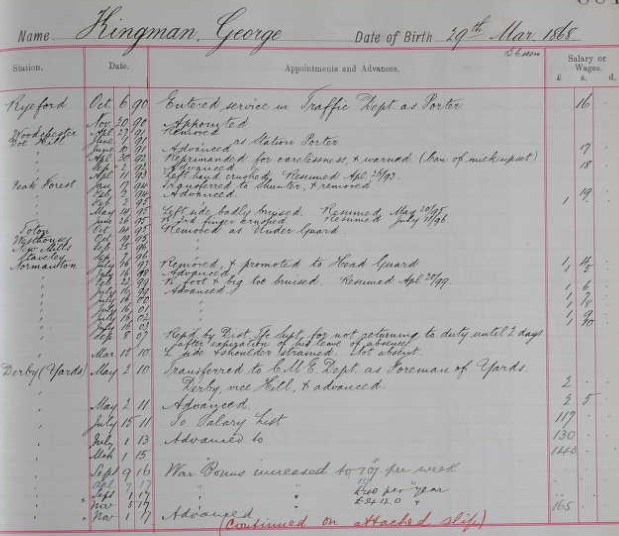
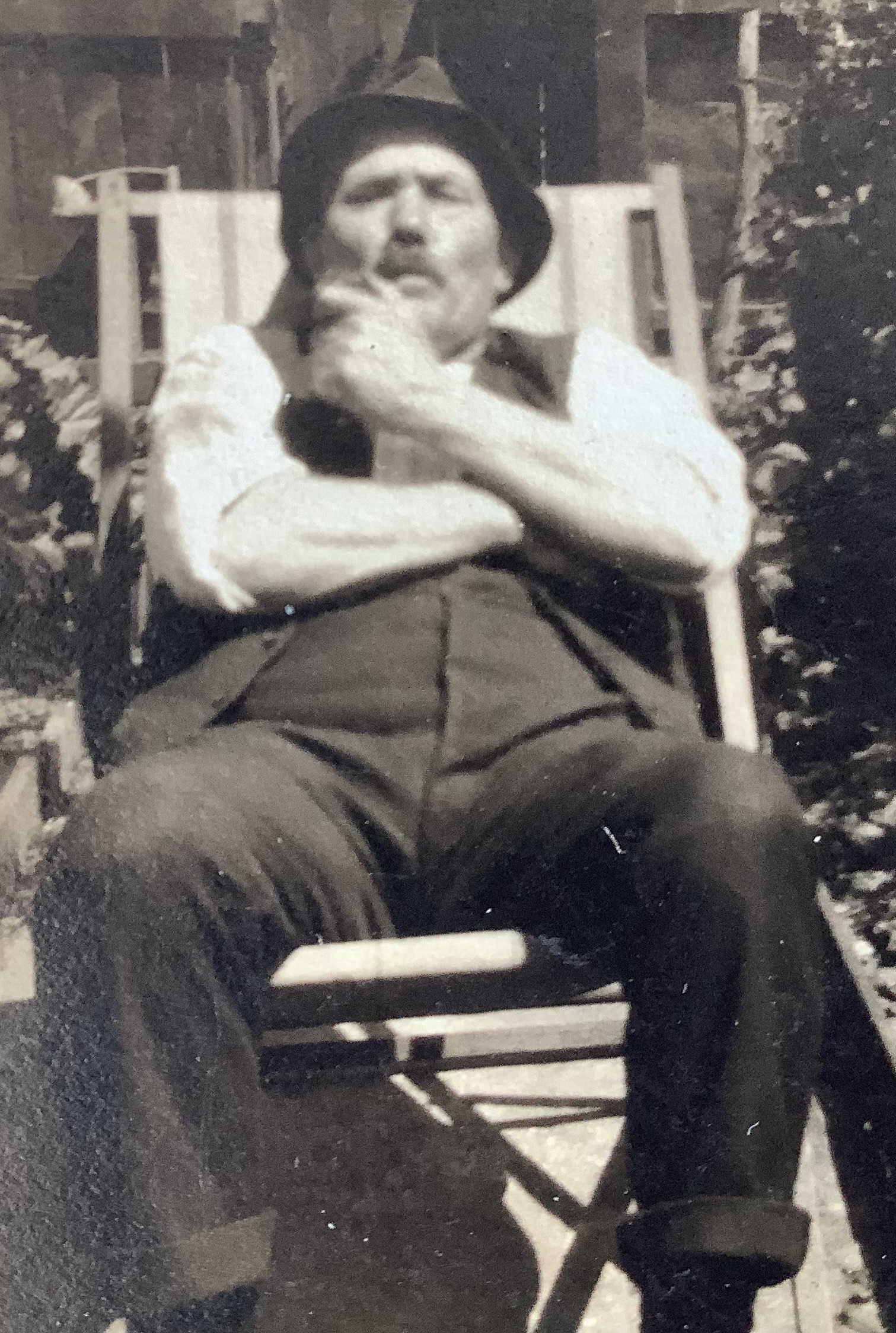
George Kingman started his career as a Porter in the Traffic Dept at Ryeford on the 6th October 1890, aged 22, on 16 shillings/wk. He’d been born at Symondsbury, Dorset, on 29th March 1868. He had a brief spell at Woodchester the following May then left the area permanently for posts in the Midlands – initially as a Station Porter at Doe Hill, Derbyshire from June 1891 until January 1894 when he moved to Peak Forest climbing to the rank of “Under Guard” by October 1895. There were short appointments in the same role at Westhouses, New Mills and Staveley until a promotion to “Head Guard” and a move to Normanton in July 1897 where he remained for the next decade. On 2nd May 1910 he became “Foreman of Yards” at Derby the location of the Headquarters and Main Works of the Midland Railway. The 1921 census still has him in that role. WW1 bonuses had boosted his pay to £165 by 1917.
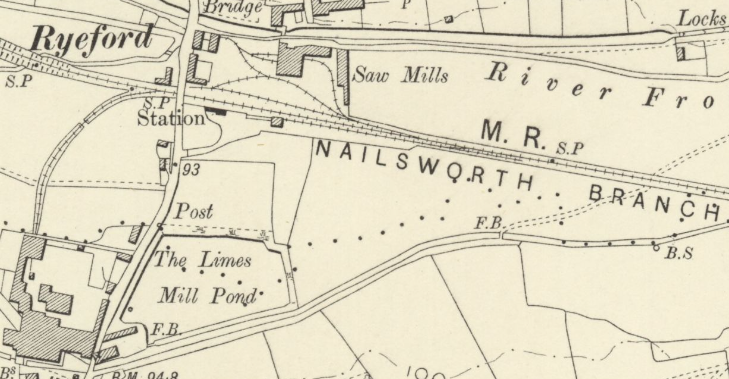
An Ordnance Survey map of 1881 shows a passing loop to the east of the station and sidings to a timber yard to the north of the line but no siding to Kings Stanley Mill to the south of the station. The latter is present on 1901 and 1920 maps but is shown removed on a 1936 map, along with truncation of the timber yard tracks.
Stonehouse:
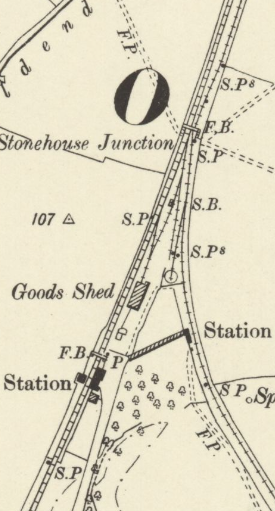
Stonehouse was a combined station and so rather different from the others on the branch. The original part of the station was opened in 1844 with two platforms straddling the Gloucester–Bristol mainline. A separate single platform was added just at the start of the branch and connected to the rest of the station by a walkway. The station was largely staffed as one entity although in 1906 the records have a J. Foyles as the Branch Porter Guard on 20 shillings/wk. The only mention of Guard duties is as a combined role with other responsibilities, e.g. in June 1884 J.A. Prude is listed as Station Porter, Guard and Shunter (14 shillings/wk), a position he resigned form on 24/3/1904. In September 1888 A. H. Waldron is recorded as Station Porter Guard, having moved from Brierley (Oxford Joint line). His starting pay was 12 shillings/wk, rising to 17 shillings in August 1898 and 19 shillings in October 1906.
Stonehouse had the greatest variety of job titles of any station on the branch. In the period 1871 to 1908 there were: 4 Station Masters, 4 Assistant Porters, 4 Booking Clerks, 1 Branch Porter Guard, 21 Gateboys, 19 Gatemen, 1 unspecified Goods, 16 Goods Clerks, 1 Goods Foreman, 5 Goods Porters (all 1870s), 1 Machine & Goods Clerk, 7 Machine Youths, 11 Pointsmen, 22 Porters, 1 Porter Signal, 2 Relief Pointsmen, 1 Signal Porter, 4 Signalmen, 5 Station Porters, 1 Station Porter/Guard/Shunter, 1 Station Porter/Guard; at total of 132 individuals.
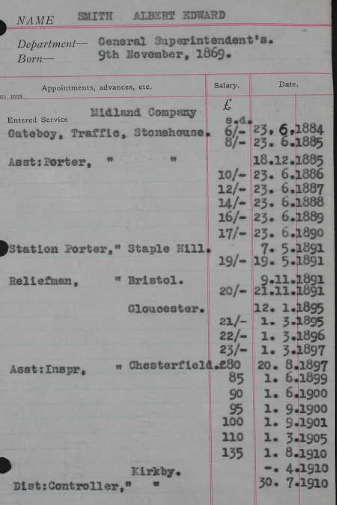
The lowest grade was the Gateboy with a starting pay rate of 6 or 8 shillings/wk consistently throughout these decades. On-site progression could though be quite rapid to Assistant Porter, sometimes via Machine Youth, or even directly to Porter. Ten of the 21 Gateboys followed this route. Albert Edward Smith, for example became an Assistant Porter after 18 months which gave him access to a pay scale that had lifted his income to 17 shillings/wk by May 1891, when he moved on to be a Station Porter at Staple Hill, Bristol. By 1910 he was District Controller at Kirkby (?Stephen). H. Anstey moved from Gateboy to Machine Youth in under 5 months in 1874 (a pay rise of 2 shillings), and then became an Assistant Porter 3 months later with another 2 shilling boost to 10 shillings; and all whilst working at Stonehouse. The role wasn’t for everyone. H. Wilkins (1875), A. Preedy (1882) and J. H. Bainton (1904) all resigned as Gateboys within a year. Sadly B. Blick was killed on 1/5/1879 whilst in post, though it is not stated whether this was related to his job.
The pay for Gatemen ranged from 16 to 20 shillings/wk with little prospect of increase without promotion. The starting pay for Assistant Porters was generally 10 shillings/wk but with a better outlook of increase and career progression. Porters pay ranged from 14 to 20 shillings/wk.
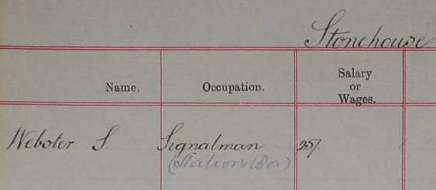
The pay for Signalmen, Pointsmen and Relief Pointsmen were similar and in the range 21 to 25 shillings between the years 1875 and 1894 where data is available. The majority of Clerks at Stonehouse were Goods Clerks, rather than Booking Clerks, but taking the two classes together average pay was £43/yr (range £23-£65). This was around 16.5 shillings/wk but in most cases the pay is quoted as an annual amount suggesting that they were salaried rather than being paid an hourly rate.
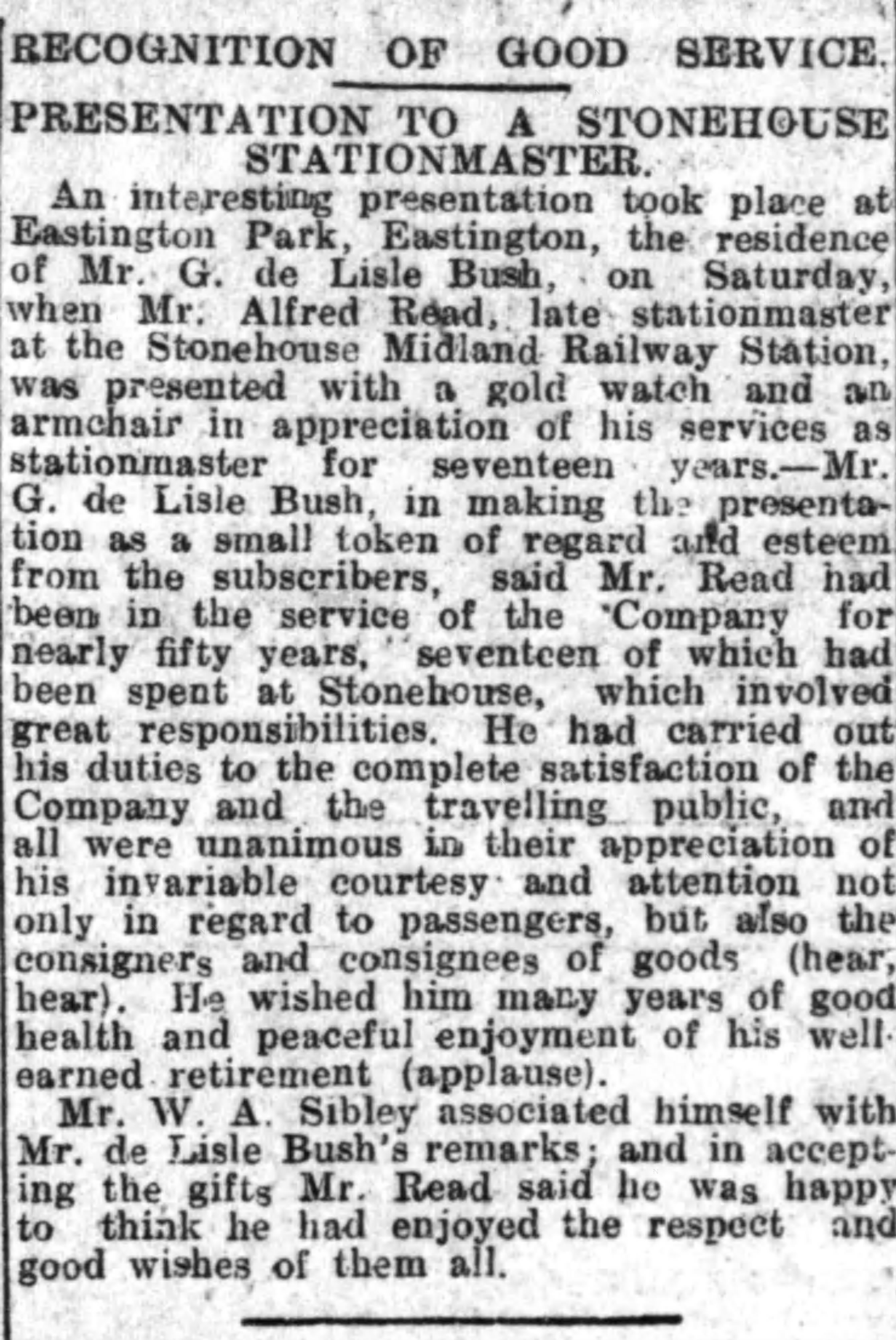
Retirement event for Stonehouse Station Master Alfred Read; after 17 years in the post.
Pay Trends
As a general rule pay increased with promotion and, for some grades, for time in post. However some other trends are apparent. On 13th December 1878 six Porters, on 3rd January 1879 two Gatemen and a week later a Pointsman all suffered pay reductions; in each case by 1 shilling.

One of these Porters at Ryeford and two at Woodchester had had their pay increased from 17 to 18 shillings on the same day the previous February. Was their initially higher pay an administrative mistake? No reasons are given for any of these pay fluctuations and I cannot discern any. Time in service doesn’t seem to be a factor as it ranged from 1 month to 4 years. One of those affected was W. White, a Porter at Dudbridge. He moved to Nailsworth in the same role and pay, but on 1/3/1881 took on addition Guard duties with a lift in pay to 20 shillings. That may have been some compensation but he resigned on 4/12/1886.
The pay reduction of E. Corph, a Porter at Stonehouse, is perhaps more understandable. Initially on 20 shillings/wk his income was reduced to 18 shillings on 11/5/1877. This was related to illness and incapacity and he later opted to drop to 17 shillings rather than be laid off. He died in post.

It was a similar story for W. Shill. He seems to have started as a Porter at Dudbridge in October 1877 but on 30/8/1878 he is recorded as being “incapacitated through illness.” He was reinstated 18/3/1879 with a pay reduction from 18 to 17 shillings. Sadly he died in post on 1/10/1893. Perhaps these cases show an element of flexibility and compassion by the employer. The men were no just discarded immediately they had health issues. Hanging onto a job at this time was more crucial than usual in a society with only rudimentary social safety nets. There was a continuous depression in the British economy from 1873 until as late as 1896.
E. Smith had been a Signalman, possibly elsewhere, but he became a Porter at Nailsworth and on 13/7/1886 he was downgraded and his pay reduced from 21 to 17 shillings/wk.

In some instances pay seems to have been higher in the 1870s, shortly after the line opened, compared with later decades. For example the Porters at Stonehouse received an average of 17.4 shillings/wk in the 1870s compared to 15.9 shillings thereafter with data up to 1908. For the Stonehouse Clerks the averages were £51/yr pre-1880 compared to £42 thereafter. However I don’t have the expertise to determine whether or not these differences are statistically significant. When the Porters for all the stations on the branch are taken together the 1870s income is only greater by 1 shilling/wk.
Career Moves
Pay and career advancement could be achieved by moving. Because of its rural setting and position in a secluded valley it is tempting to think of the branch as an isolated entity but it was far from that. It was part of a big beast – the Midland Railway.
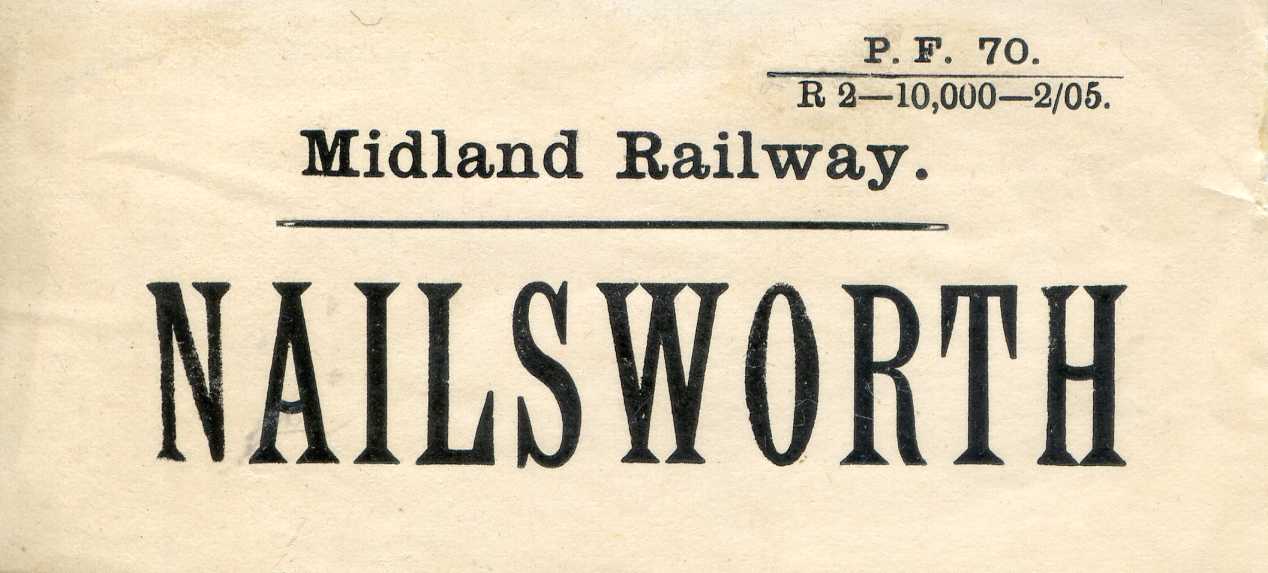
Employees could come from, or move to, anywhere within the Midland Railway network and significant promotions, e.g. to Station Master, did require experience elsewhere. Charles Hyde, a locally born lad, spent time on the railway in Ilkley, Yorkshire before returning to Nailsworth as Station Master. Others moved away permanently to higher profile positions, like George Kingman who became a foreman at Derby Works, and William Wearn who starting at Woodchester and became a Relief Station Master at St Pancras. Folk could though move the other way achieving higher ranking positions by coming to the branch. G.J. Maggs, a Porter at Dudbridge in 1904, had at one time worked on the Midland and Great Northern (Joint) Railway in East Anglia.

Someone going in the opposite direction to that neck of the woods was W. Venn who’d starred on just 5 shillings/wk as a Machine Youth at Stonehouse in July 1876. By April 1878 he was a Booking Clerk there on 9 shillings, rising to 13 shillings in 1881. By 1886 he had progressed to Goods Clerk on 23 shillings/wk at which point he was moved to Kings Lynn. C. Ford a Porter at Nailsworth in 1875 had previously worked at Skipton, and S.J. Hayman moved to Nailsworth as a Porter Guard from Sheepsbridge Station, Chesterfield in June 1891, for 17 shillings/wk.
Those with less grand ambitions, or who wanted to remain in the area, could obtain limited promotion on the branch, or move sideways. C.R. Morse started as a Porter at Dudbridge in 1899, moved to Nailsworth in 1900, then onto Ryeford in 1903. C.C. Bowker was a Guard at Nailsworth in 1889 on 20 shillings/wk but got 24 shillings/wk in the same role at Stonehouse 2 years later.
A.S. Childs started as an Assistant Porter at Ryeford in May 1905 on 10 shillings/wk but made the move up the road to Stonehouse to become a Porter and was on 16 shillings/wk by January 1908. Edward Thomas Shill started as a Carriage Washer at Nailsworth in December 1895, aged 18, on 12 shillings/wk. He was a Porter there by 1897, then moved to be Station Porter at Dudbridge with pay nudging up to 19 shilling/wk, before leaving for Matlock Bath around 1902.
In October 1877 A.Willsher was taken on as a Porter at Stonehouse on 14 shillings/wk. In April 1884 he profited from the resignation of A. Cresswell and was promoted to Foreman in his place and by December 1906 his pay had reached 26 shillings/wk. A.W. Barnfield enjoyed quite a jump in pay from being an Office Youth at Woodchester on 8 shillings/wk in June 1897 to £35/yr (13.5 shillings/wk) as a Goods Clerk at Stonehouse in April 1900.
W. Burgess is listed as a Porter at Dudbridge as of 14/6/1894 on 16 shillings/wk which rose to 17 shillings a year later. He was subsequently transferred to Avonmouth Joint Station but on 21/9/1899 was brought back to Ryeford on 19 shillings/wk as a Porter Signalman. On 16/5/1901 he is a Signalman back at Dudbridge allocated to the Junction Box on 21 shillings/wk which rose to 22 shillings on 15/5/1902, then to 23 shillings on 14/5/1903; note the increases occur on the anniversary of his appointment
Deaths
A number of deaths or incapacitating health issues have already been mentioned above. These are in relatively young working age men and the deaths do not appear to be related to accidents at work. This was an era when infectious diseases and periodic epidemics were common. This included such conditions as Smallpox, Cholera and other dysenteries, Measles, Scarlet Fever, Diphtheria and particularly T.B. In addition to those already mentioned the following died whilst working on the stations of the branch: H Adams Nailsworth Goods Porter 6/3/1875, B. Smith Stonehouse Pointsman, 25/11/1875, R. Neal Stonehouse Gateman, 30/1/1877, C Bliss Stonehouse Gateman 22/12/1874, just 4 months in post, another unidentified Stonehouse Gateman 1/4/1874, and S. Finch a Stonehouse Goods Clerk, 21/1/1894. To this roll call there was also E. Remes, a Stonehouse Pointsman, who was incapacitated due to illness.
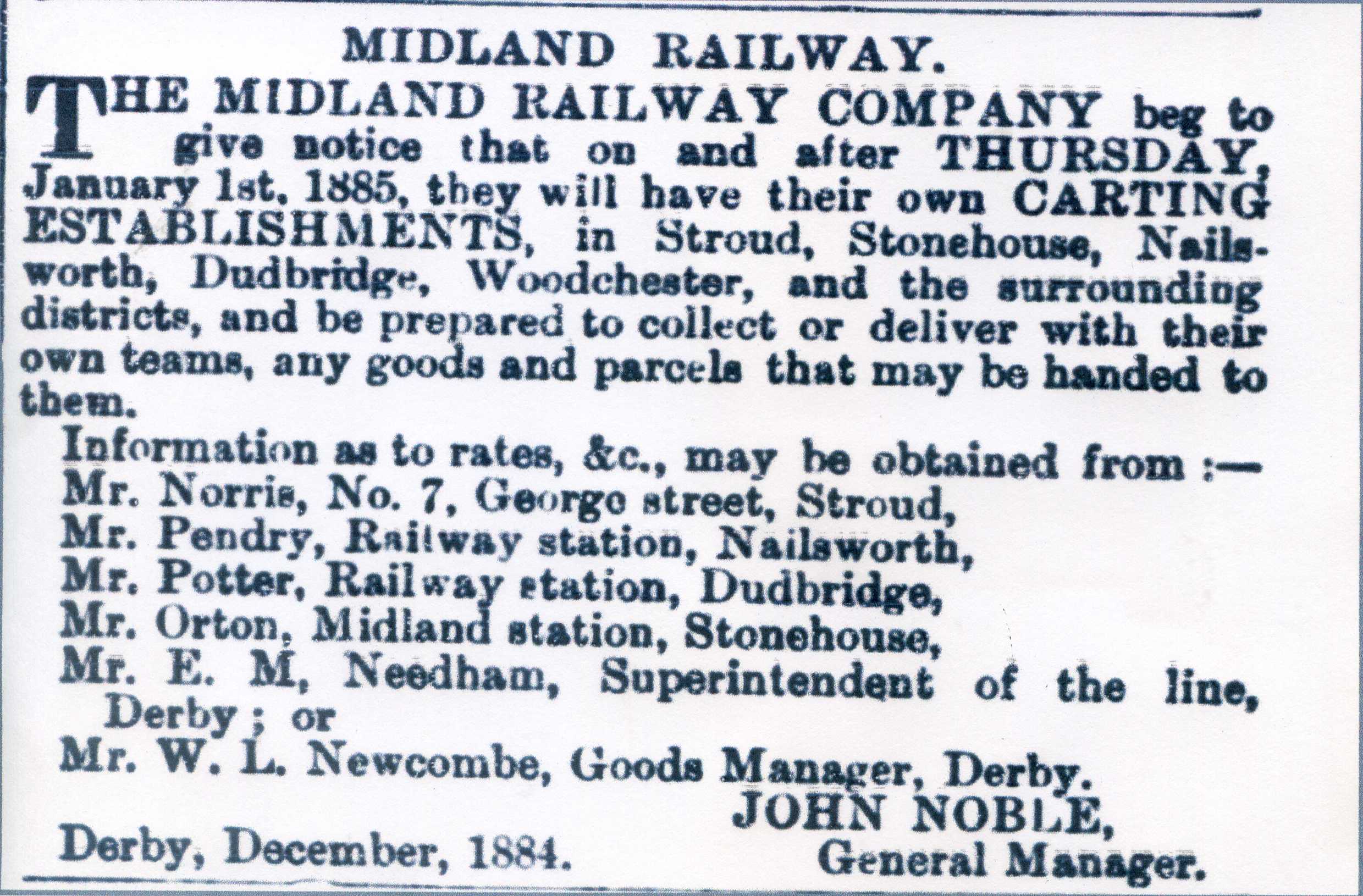
Carting Services for the line as from 1/1/1885. Below: notice published in The Gloucester Journal, 10th January, 1885
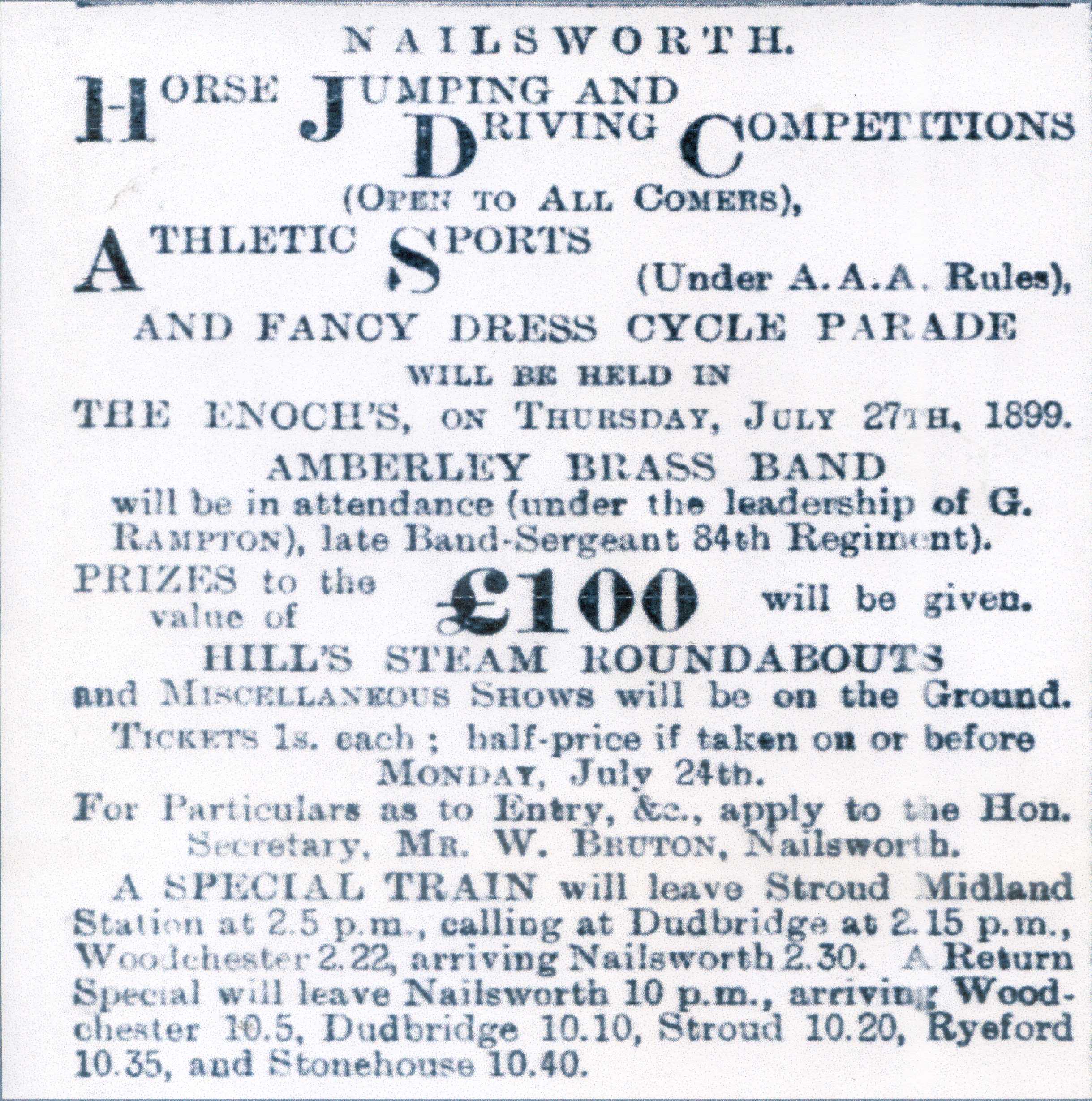
Special Trains. Occasionally additional services were put on for specific events. Below an announcement in The Citizen, Thursday, 13th July, 1899.
The railway in later years
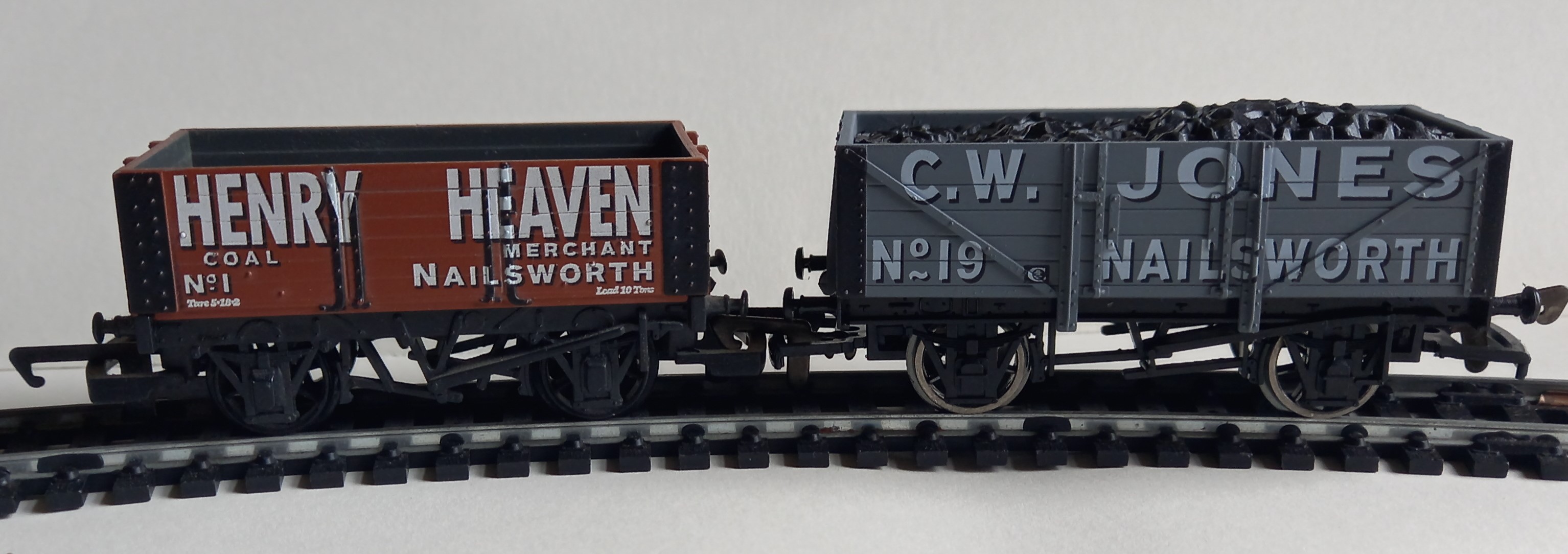
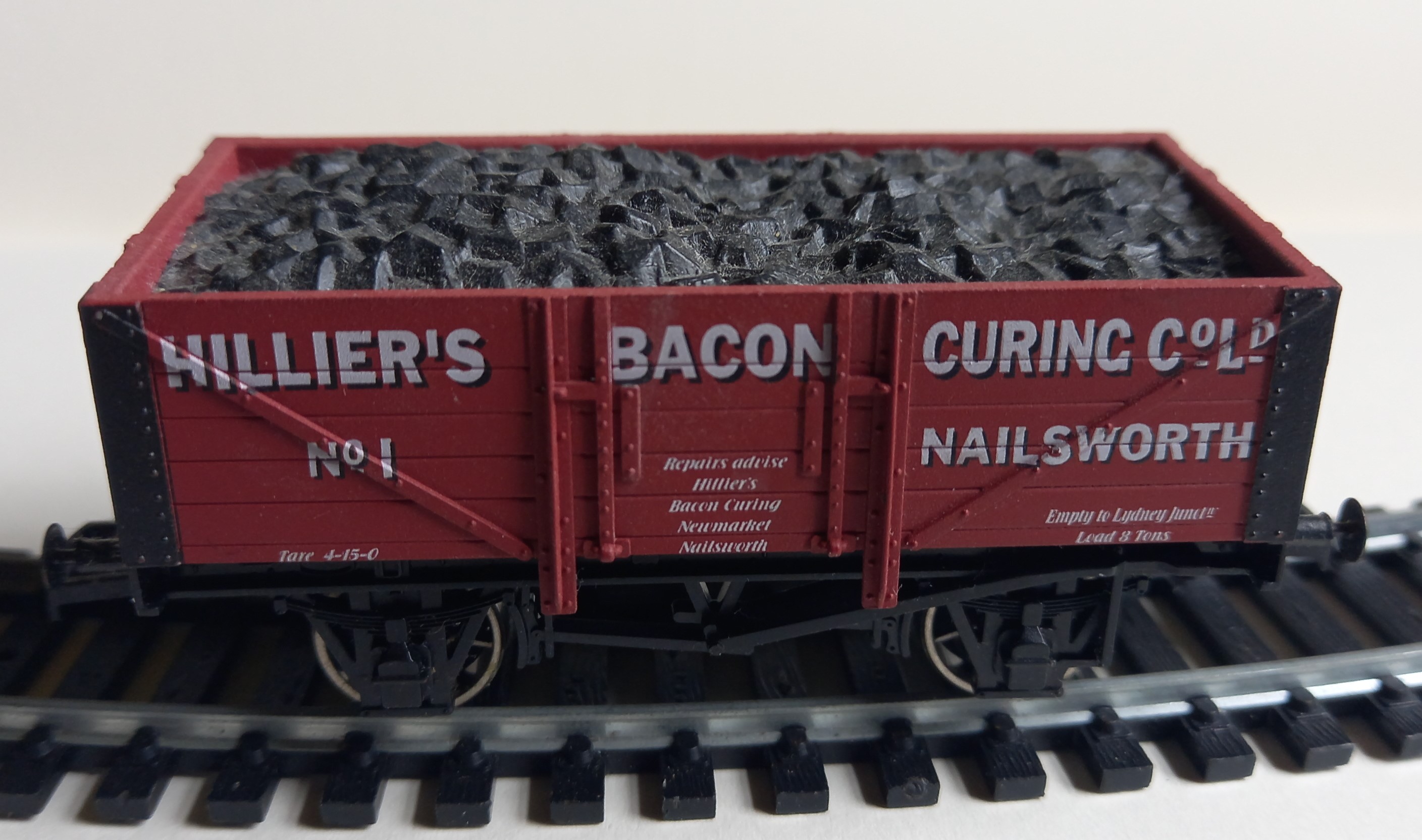
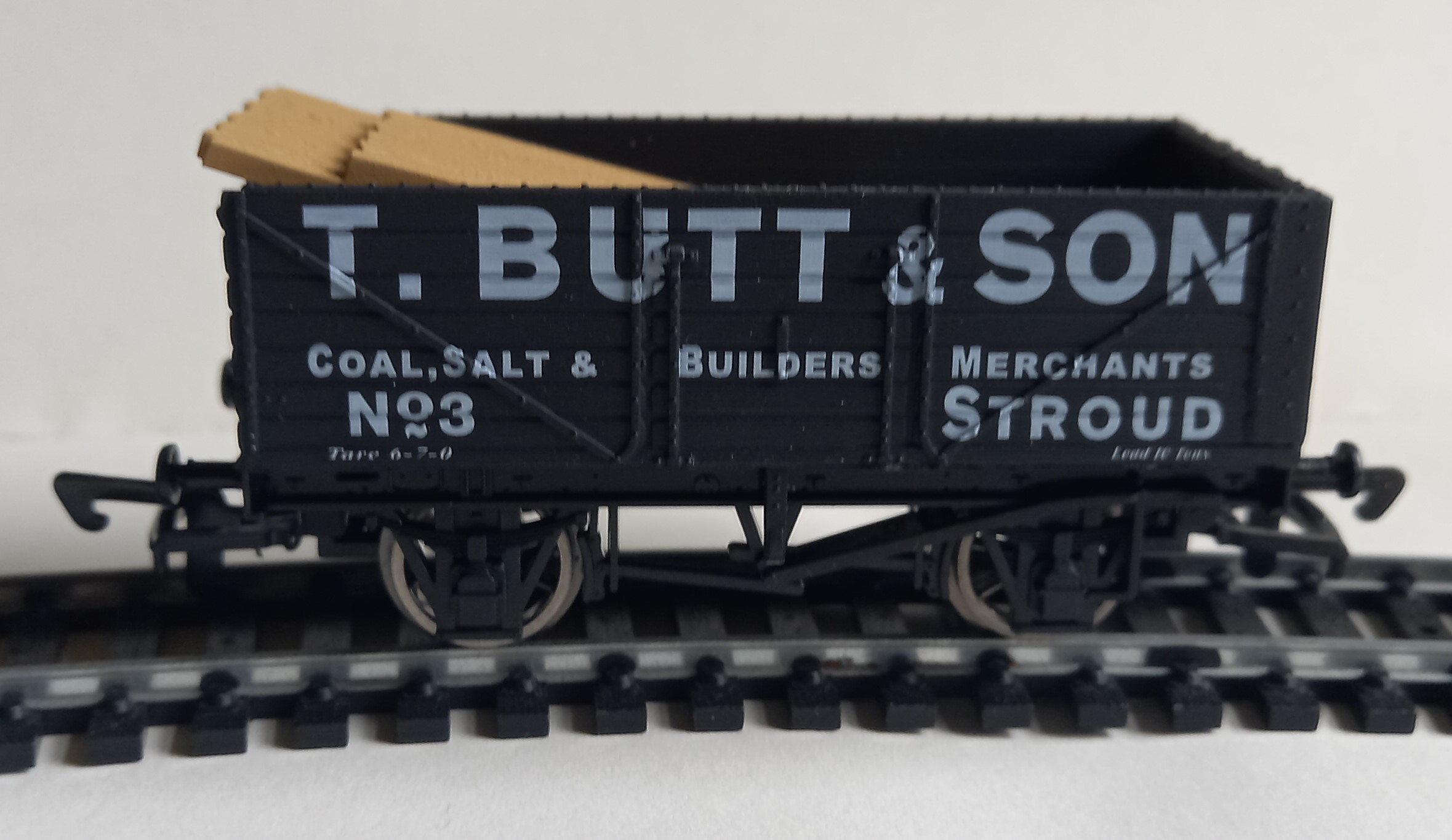
Several Nailsworth Coal Merchants had wagons in their own livery, as did Hillier’s Bacon Curing Factory at Newmarket on the edge of the town; as shown by these models. There were animal pens in the Goods Yard for bringing in livestock for Hillier’s.
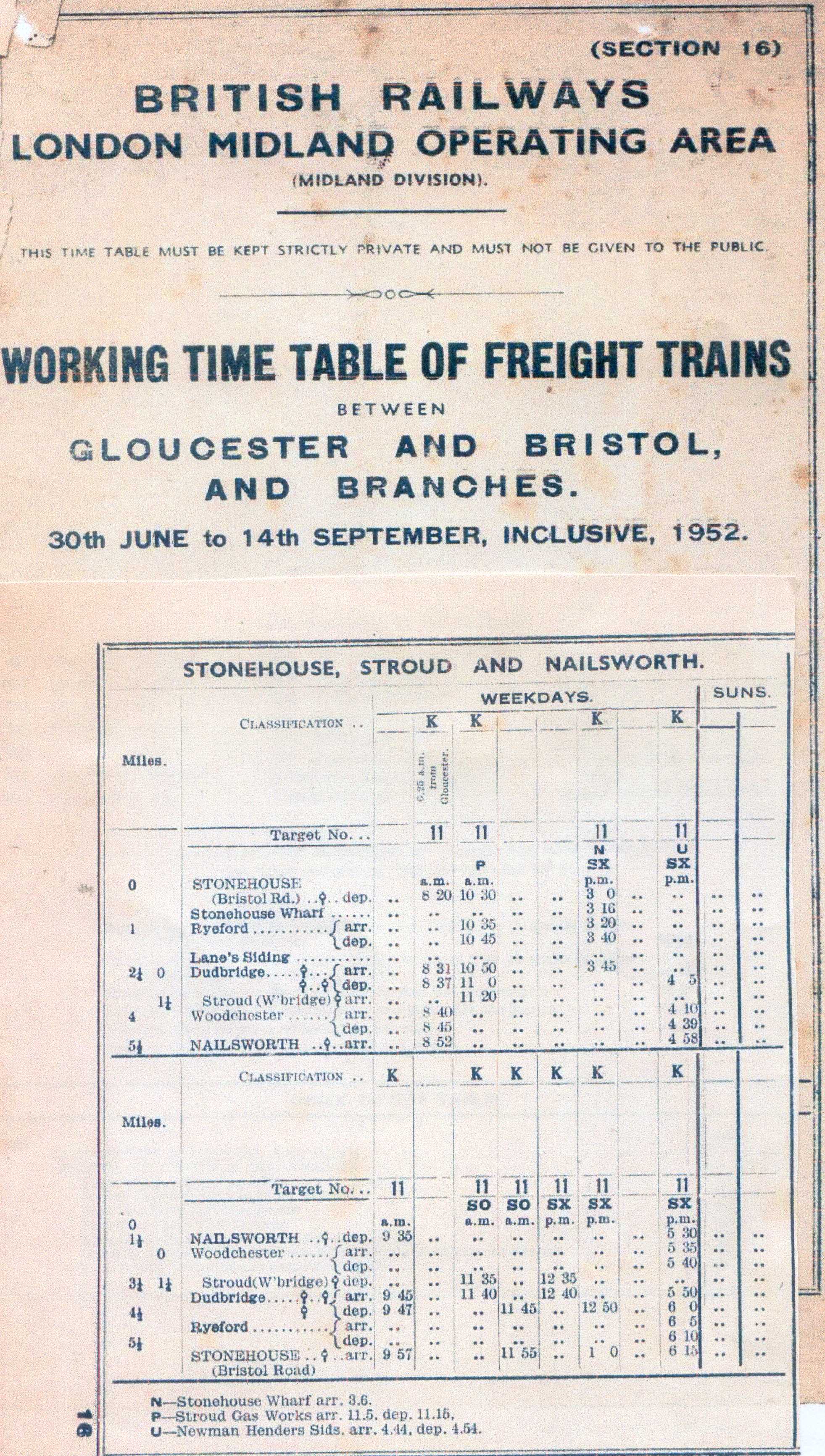
In 1923 the Midland Railway, and thus the Nailsworth branch, became part of the London Midland & Scottish Railway. In 1948 it became part of British Railways. After the loss of passenger services in 1947 a regular, every weekday, freight service continued (see timetable from 1952). The line closed entirely in 1966 as part of the Dr Beeching cuts.
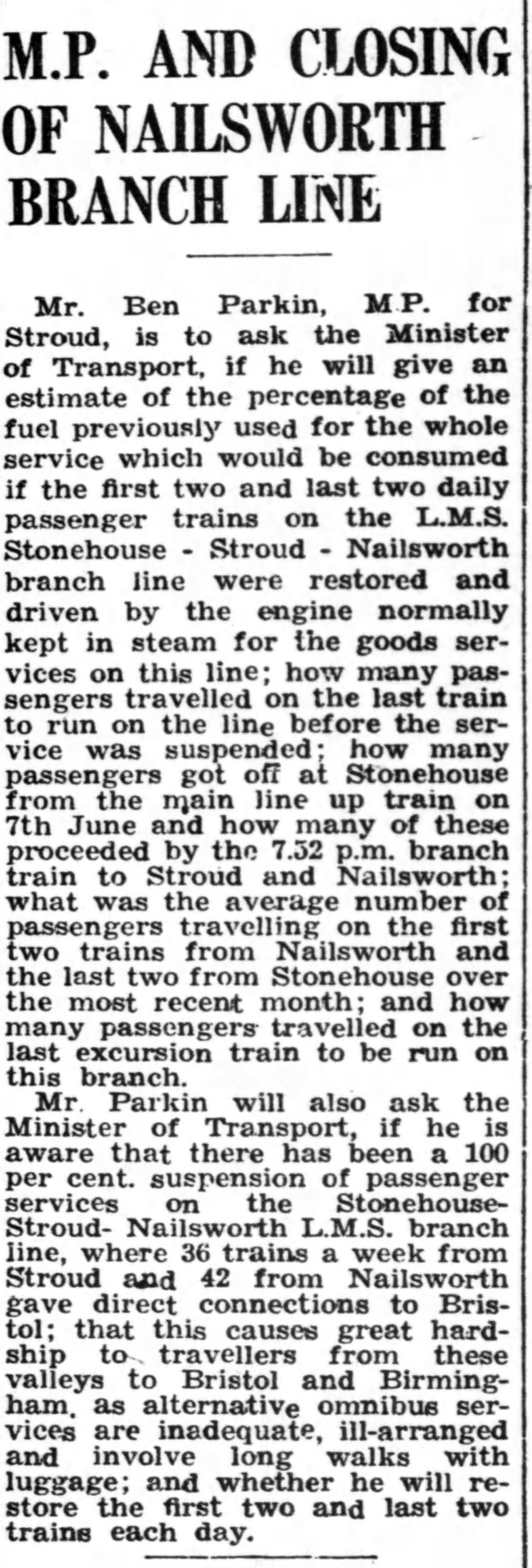
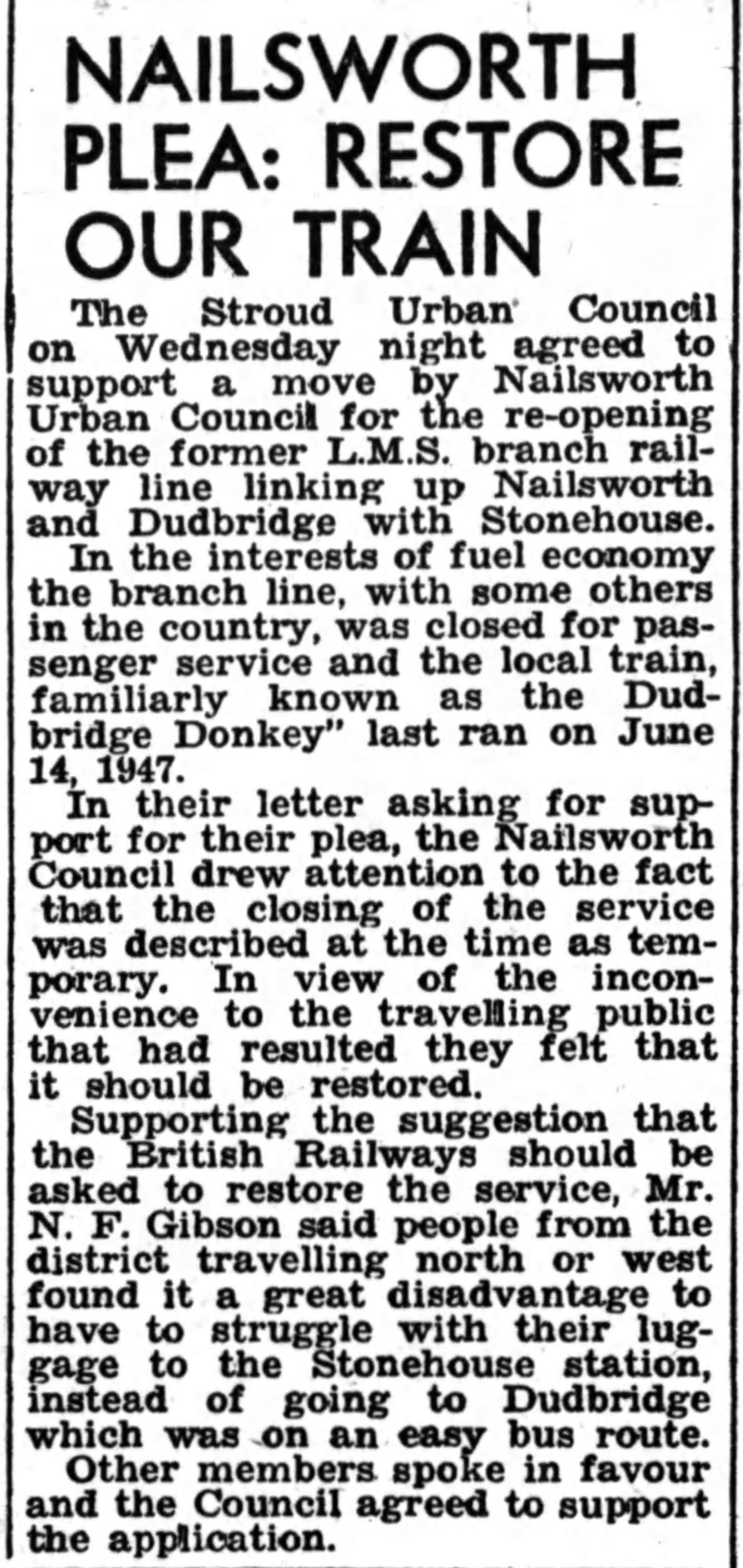
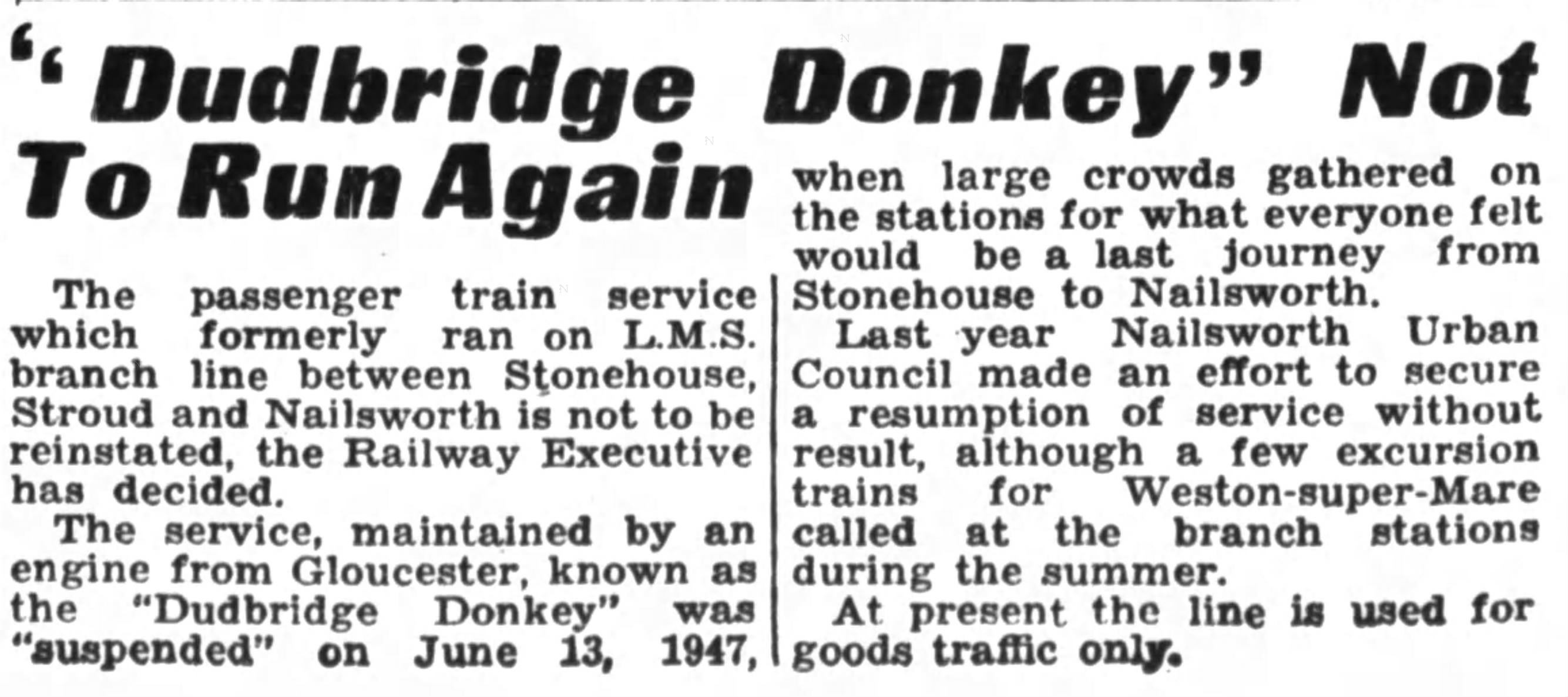
as reported in The Citizen newspaper, on 20th June, 1947.
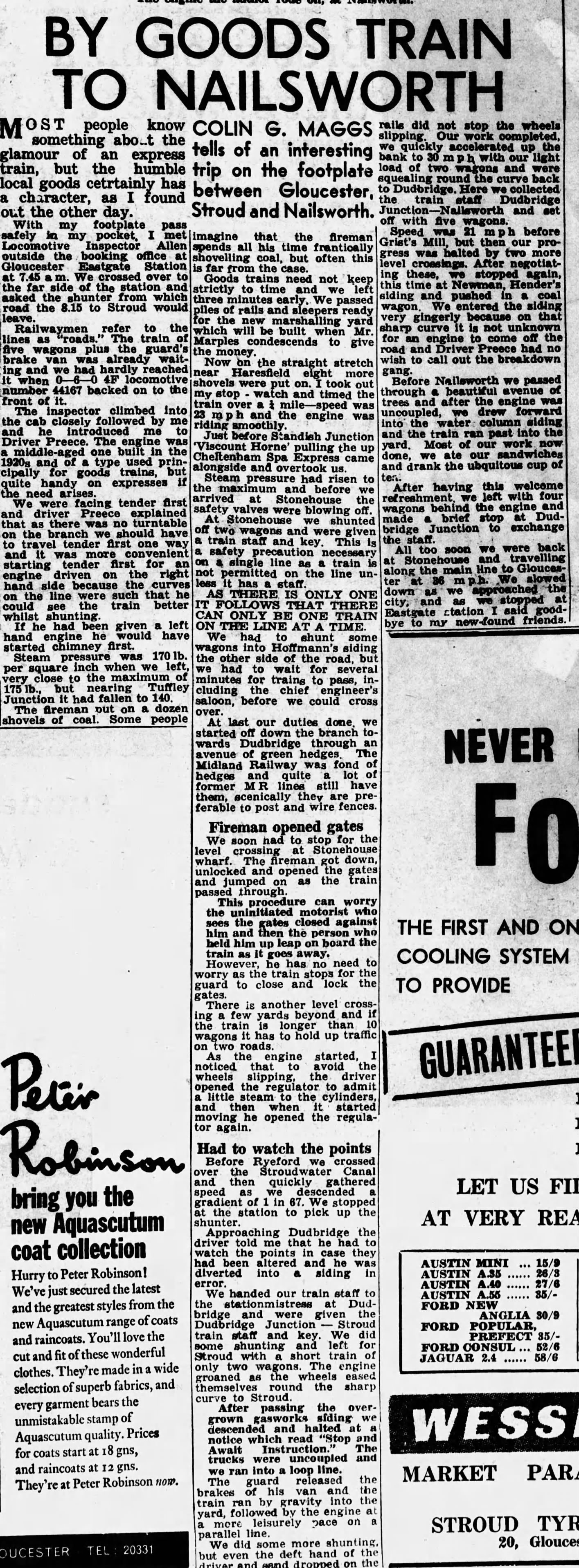
The railway author Colin Maggs took a ride in the locomotive cab of a Goods Train to Nailsworth in 1962; as reported in The Citizen on 10th May, 1962. In 2000 he published a history of the branch.
An Appeal
In its 99 years of existence, it was a vital part of the local scene. If you have recollections or stories to tell about the railway to Nailsworth, or as yet unseen photos of it, please share them with the folk at Nailsworth Archive.
The Archive is based in the Town Hall and open Monday to Friday 10.00am to 12.00pm
Contact details:
Tel: 07745084778
archives@nailsworthtowncouncil.gov.uk
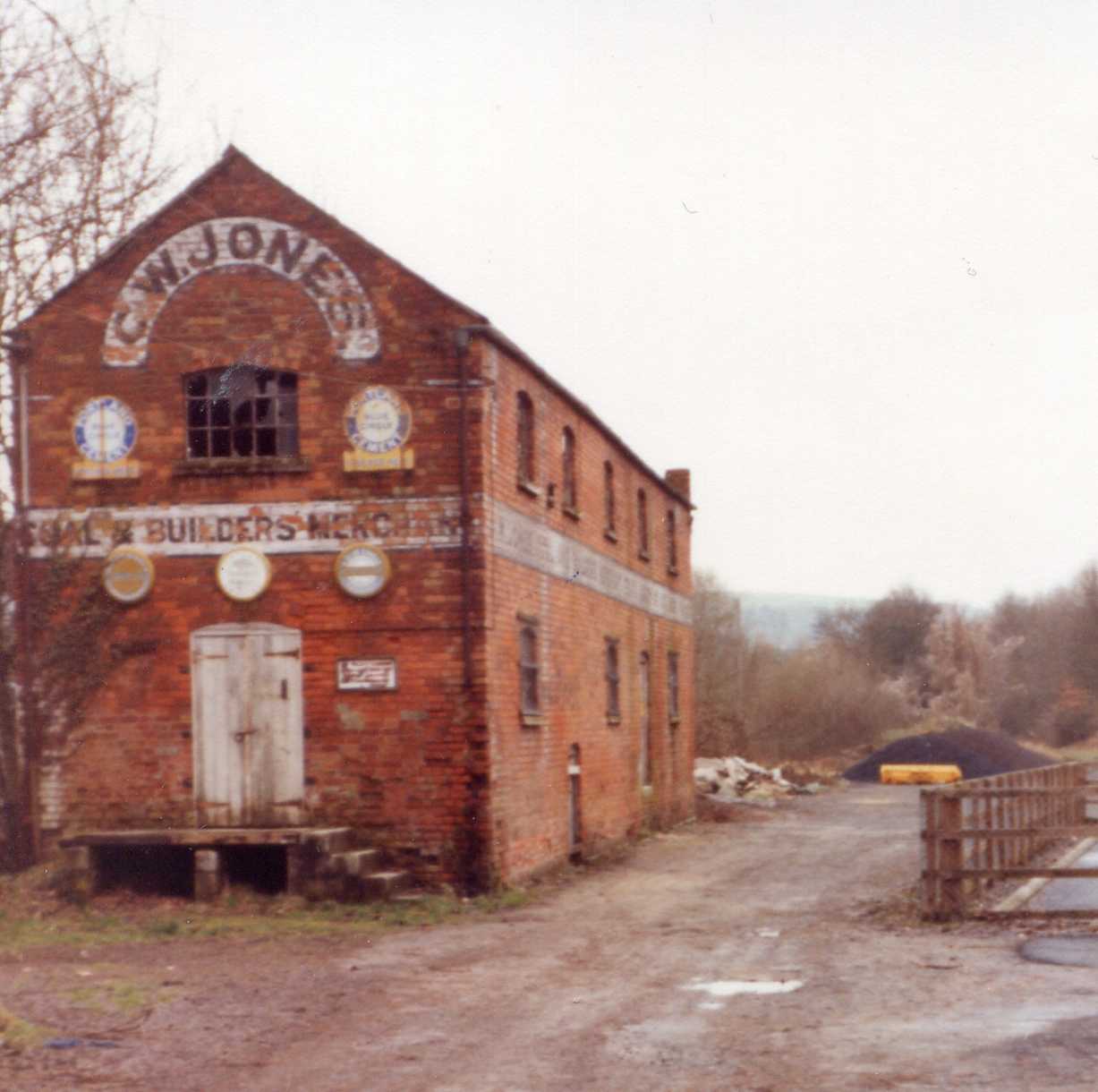
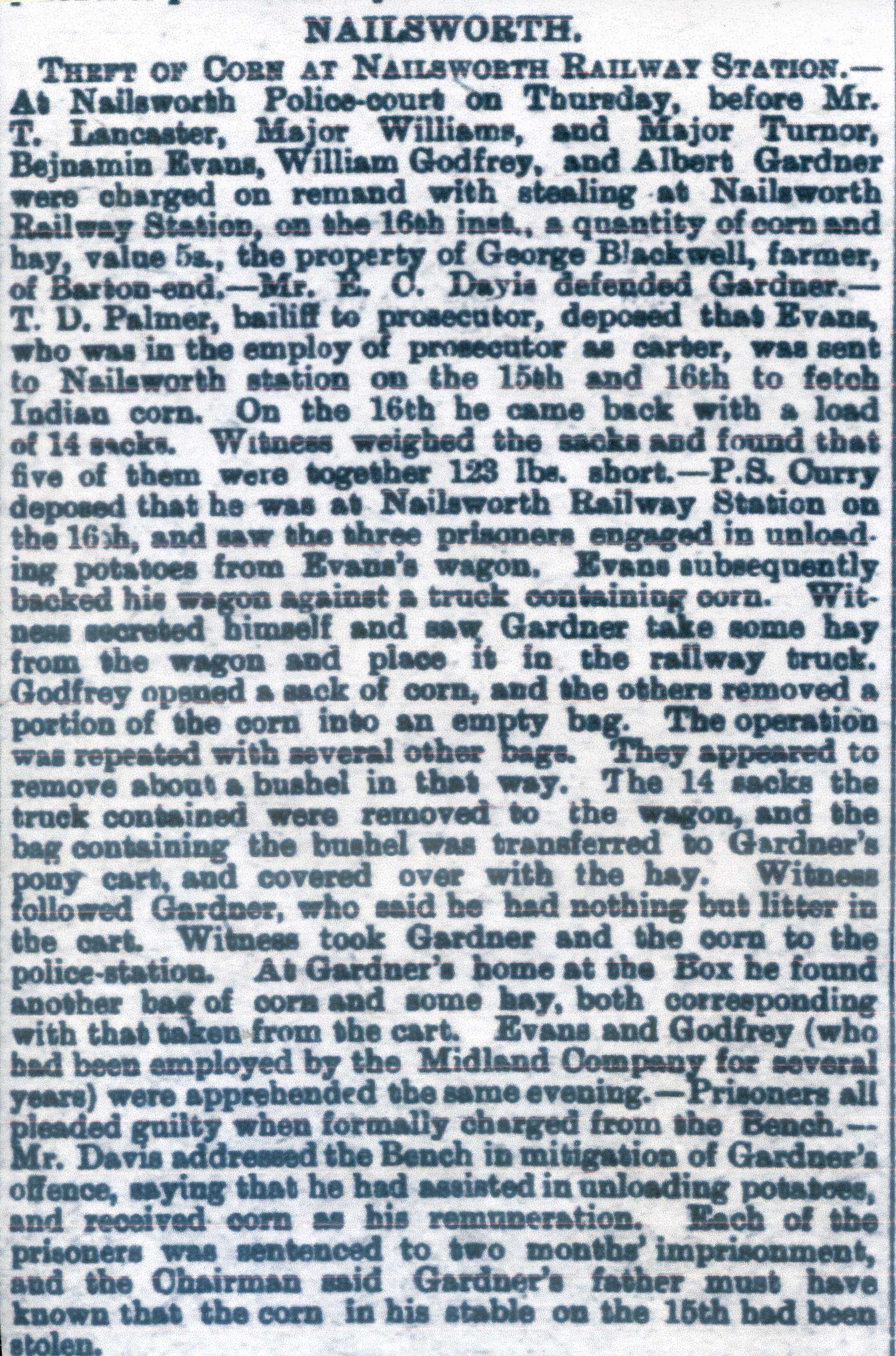
some insight into the commercial activity and goods being brought
in by rail; article from The Gloucester Journal, March 23rd, 1889.
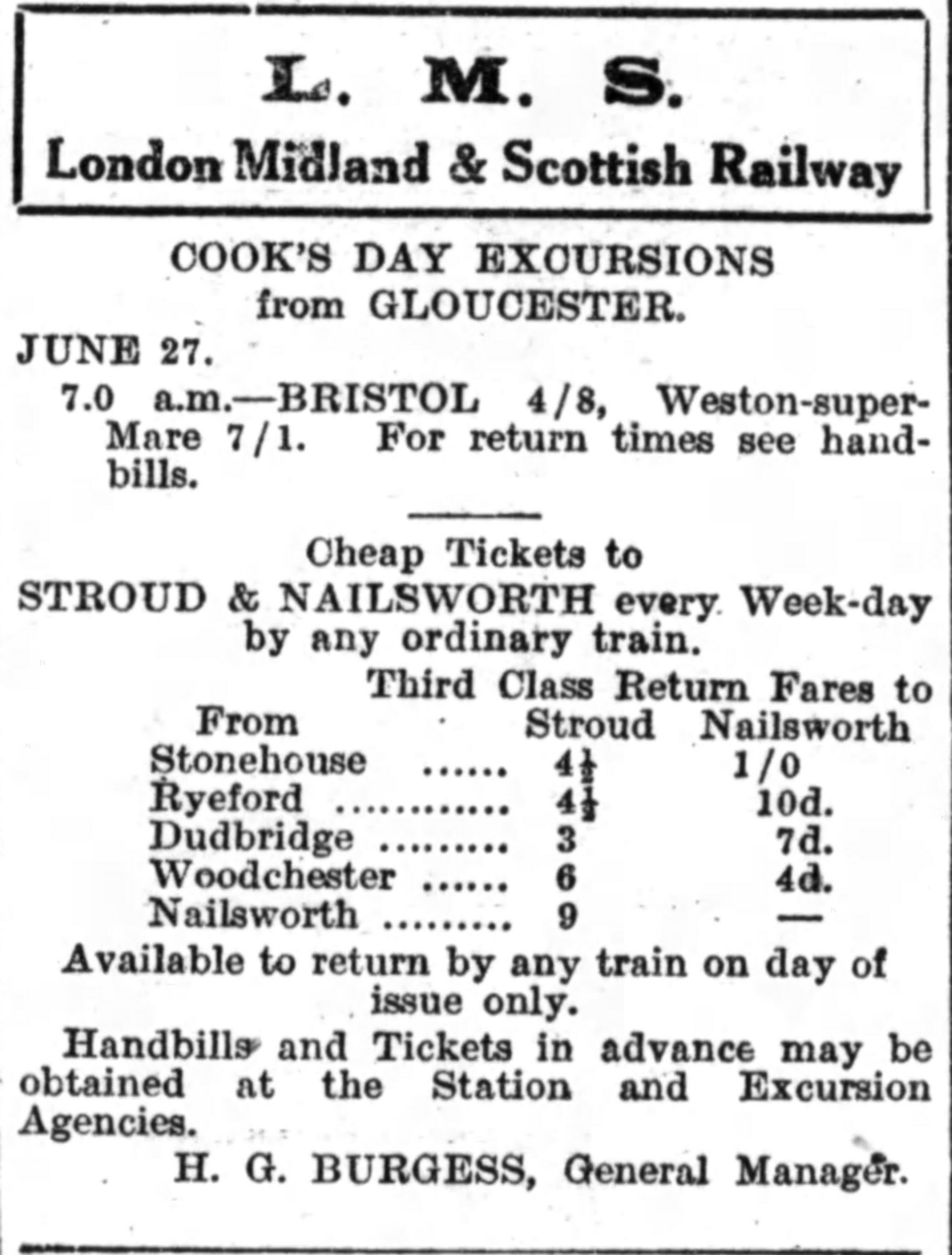
on the 20th June that year.
 oldrailwaystuff